Unfortunately, we live in a world where public opinion (skewed by fossil fuel companies or otherwise) is a huge driving force. We can lament what the world would be like if only people were more knowledgeable, but at the end of the day it's the ecosystem we have to operate in.
Fusion power has indeed had high R&D costs, but so has any significant project before the ROI starts to kick in. Fusion power (especially the types that don't generate a neutron flux) is safer and more productive in principle compared to fission, and I have high confidence I will live to see a commercial fusion reactor come online in my lifetime.
I don't work as a physicist (but I got my degree in Engineering Physics @ CU-Boulder, 2009) and I went to see Interstellar in IMAX on opening night. I really enjoyed it overall, and the scenes involving the realistically-rendered black hole were worth it alone.
I'm relatively easy to please when it comes to movies, but to each their own of course.
Theoretical LENR device would be comparable to an RTG [1] because at high heat the device would melt itself. It's more about a trickle of stable power, rather than being used as a cell of a power plant. So, ignoring support infrastructure and focusing on the size of the power generator, we have:
Using the power source for the voyager probe as an example:
RTG size: 0.5m x 0.5m x 1m == 0.25 cubic meters.
RTG power: 2400 watts (thermal)
RTG power density: 9600 watts per cubic meter
Using ITER as an example for the scale of fusion power plant:
Reactor size: 800 cubic meters
Reactor power: 500,000,000 watts (thermal)
Reactor power density: 625,000 watts per cubic meter
So yeah, theoretically it would be compact, but low power density. Enough to power a space probe, but not our civilization.
If it can power a space probe, it can power a car. If it is even a fraction of the power of an RTG but without the same issues with fuel, it could be civilization changing.
If it is not that compact but it can still be placed inside homes, ditto.
I got my undergrad in Engineering Physics from CU-Boulder and talked with many professors about fusion research (plus keeping up with developments since then).
Putting aside all the controversy of LENR (low-energy nuclear reactions, the official name for cold fusion) and assuming that the theory actually results in usable tech (for once), the first line of the NASA article hints at where a device's power density would be competitive:
> "A team of NASA researchers seeking a new energy source for deep-space exploration missions"
which tells me that a theoretical device would be a replacement for current RTGs [1]. Low but consistent power for niche applications.
But in general I wouldn't get your hopes up. The higher-energy types of fusion power are far more promising for world-wide civilization-powering clean energy.
The part that I'm not grasping about this is how you harness the power that is created. I think it's great that they can start a fusion reaction this way. But how does this become practical, in theory? Does the lattice radiate heat once fusion starts or something?
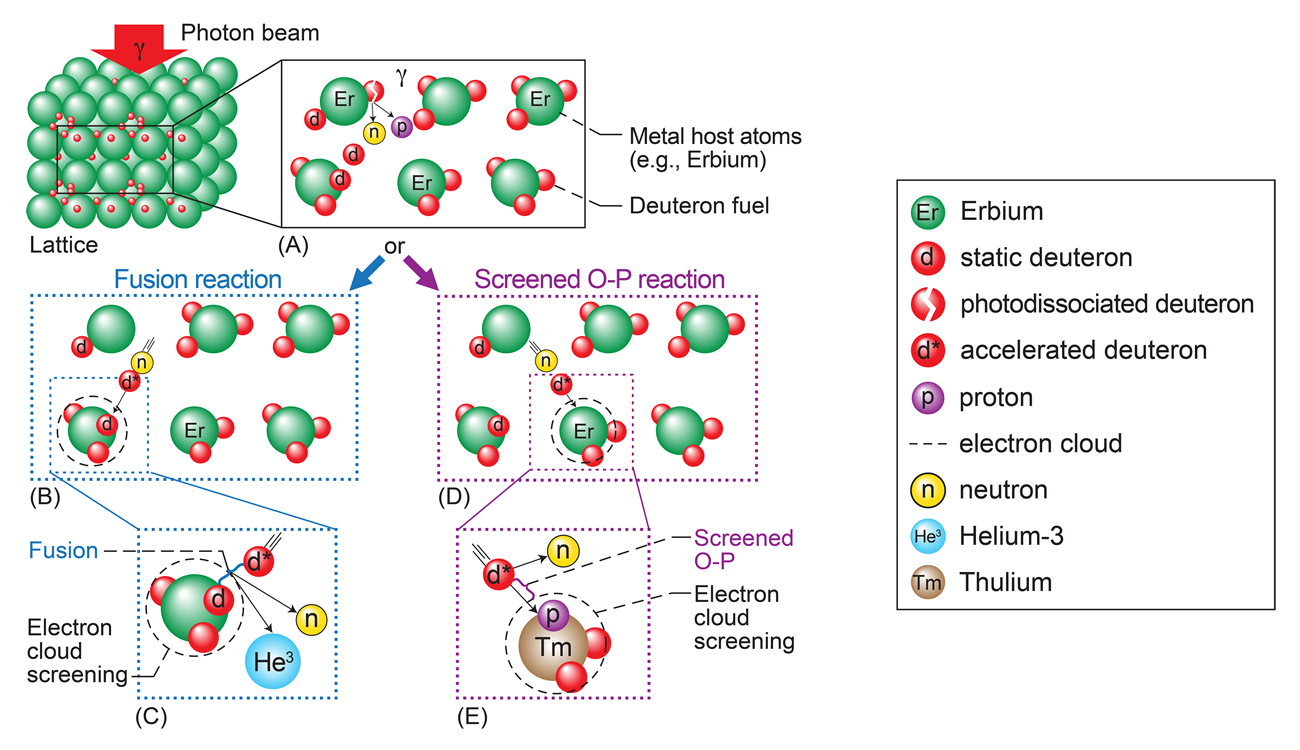
It appears to be the same mechanism as neutronic high-energy fusion. An energetic neutron gets kicked out, which collides with some material in the cell (probably the erbium lattice), and generates heat. Which then needs to be hooked up to a water boiler to create steam, which powers a turbine, etc.
I'm much more hopeful for someone creating a Dense Plasma Focus device with aneutronic hydrogen-boron (pB11) fuel because the reaction energy can be directly captured as electricity, instead of having to capture hot neutrons to boil water.
Fusion products have particle energy on the order of 10s to 100s of MeV. Thermal machines tend to melt or evaporate when their average particle energy gets on the order of 100s of meV.
The increase in entropy on that temperature conversion alone is absurdly wasteful.
My understanding is that they are talking about bulk heating of a metal carrier, probably by a tens to low hundreds of degrees for power production. Not every particle in the medium is at Mev, otherwise it would be trillions of degrees kelvin.
In direct conversion, all of the particles used on the conversion have MeV energies. It is exactly that bulk heating that is the problem.
When you get a very low entropy source and your first step on using it consist on increasing the entropy 1000000000 times, you lose a lot of flexibility and efficiency.
Nuclear fusion is pretty much the exact opposite of a low entropy source. In any case, thermal power plants (gas, coal or nuclear) reach up to 50% efficiency with modern gas or steam turbines.
“That which can be asserted without evidence, can be dismissed without evidence.” - Hitchens's razor.
The burden of proof is always on the person making an assertion or proposition. When they do not provide proof of their claim, and another person calls it "full of shit", it is not valid to shift the burden of proof onto them to disprove the original claim.
And there's a great reason for this - the bullshit asymmetry principle: the amount of energy needed to refute bullshit is an order of magnitude bigger than to produce it.
My family visited here in 1998/99 when my dad (USA Air Force) was stationed at "Peace Vector 3" in Ismailia, Egypt. The Siwa Oasis was a fascinating place - people still lived in the ancient mudbrick houses that have been around for hundreds of years (so we were told). The whole neighborhood looked like Dr. Suess buildings because torrential rains that came once a decade warped everything and then re-dried. Just like everywhere we visited, the people were welcoming and generous, the street food was amazing, and there was more to experience than we had time for. I'd love to go back some day.
Also, we went on a tour of the dunes and salt flats and the guide started his jeep with a flathead screwdriver. That was a culture shock for my 12yo american kid self.
My dad's family is from Ismailia (I grew up in Cairo but went to Ismailia on an almost monthly basis and would often spend summer months there). It's such a beautiful town, hope you get to enjoy it too.
I once heard of the hypothesis that once the last proton decays, the universe will once more be completely uniform in every way. With nothing to distinguish any part of the universe from any other part, space becomes meaningless and the universe has once more entered a state of nothingness much like how it was "before" the Big Bang.
So, in a sense, the heat death is not so different from the big bounce.
Unfortunately I did not bother to bookmark what I had read, and can no longer find a name or anything referring to it on the internet.
> ITER was designed before the newest generations of superconductors were available. ITER is now succumbing to the escalation of commitment that sunk-costs engender. SPARK [sic] has the advantage of an agile development model and new materials and technology that combined, dramatically shortens the path to breakeven and the reduction in costs to do so.
Just imagine where we'd be if fusion science were given equal footing with other investment endeavors.
The US spends more than $850B every single year on the military. If a tiny fraction of that was spent in gaining complete energy independence, it would pay for itself in that we wouldn't need as big of a military.
One thing I think about is how boring and unambitious our institutions are. Apple has a quarter trillion in cash just sitting around. They could develop fusion or build some space stations. Bezos has 150B. We are spending a trillion on some shitty planes.
The big money holders only think about incrementing some integers in their bank account. Yeah, yeah, I know why. It's just so... lame. Build a moon colony! Cure cancer! Create free energy! Make experimental cities! Push the limits of human civilization! No, let's instead dump the fruits of society into optimizing ads and making our phones 20 microns thinner and bombing some poor people.
It may surprise you to hear that the U.S. is on track for energy independence by 2022, based on increased American oil and gas production (third-biggest oil producing country in the world) and flat domestic demand.
There is a fixed amount of oil in the earth. The next barrel of oil is always harder to get at than the last. The USA had a major technical revolution in getting fracking to work, and the price of oil got high enough for it to be profitable, and we did something amazing and are pumping a ton more oil than we were previously. Eventually that frackable oil will run low again too. The price of oil will go up, making perhaps new reserves proftable, maybe those won't be int he USA, or maybe solar/wind will be more attractive than oil at that point.
it is unknown! but we certainly shouldn't make long term 10-20-50 year plans on the assumption that the USA will be energy independent due to oil.
Maybe we can get the military industrial complex into the nuclear industrial complex instead? Though one must be careful what one is wishing for I guess.
For the trillions we have flushed down the drain in the Middle East, we could have weaned ourselves off foreign oil with renewables, without even getting into nuclear. Sadly, it goes back to the “feature, not a big” thing. :(
Not to get too far off track, but I always thought in a magical alternate universe in which I could make US policy, I'd modernize the nuclear Arsenal and ditch spending on everything else in the military. Couldn't play global policeman anymore, but nobody seems grateful to the US for that anyway. And let's face it, if it really came to a confrontation with another world power, it will end in nuclear war even if it doesn't start out like that. It seems to me that everyone is still fighting the last war. Why do you need conventional forces in a nuclear world?
What's wrong with do nothing? What business is of the US what happens in the rest of the world? I mean as much as people criticize the role they played, I think the world is better off for it. But it's a thankless job. Turning inward and leaving the world to go as it will is a valid strategy. Perhaps even the best one for the US. Nukes are good enough for self defense.
All the US intervention are based on pure self interest, nothing to do with policing the world. If anything most of the world would have been better off without US interventions, particularly latin america and middle east!
Now let's say you don't have conventional weapons.
China invades all South East Asia progressively. Would you nuke them? Russia invades Eastern Europe. Would you nuke them? If yes why hasn't the US nuked Russia yet?
Then all your allies suddenly switch side after being overthrown by dictators who are in favor of your enemies. Would you nuke them?
Another one: you are terrorists associations preparing attacks against you in camps all across middle east. Who do you nuke to defend yourself?
Conventional weapons are actually the only useful tools nowadays, because war is much more sneaky than it used to be, and it is much more about fighting for influence than really invading countries or defending you territory.
Basically no to all of the above. One can question the wisdom of not standing up to aggressive nation states attacking and conquering other states - and doing nothing. Let's say the US had invented the bomb earlier and was using this strategy during the rise of Nazi Germany. Basically the plan would be to leave Japan, Russia, Germany, Italy unchecked as they conquered state after state until the whole rest of the world fell under horrifying authoritarian rule. Until one eventually comes for the US and both commit suicide. It seems a much worse scenario than the already horrifying one we had.
On the other hand let's say all had the bomb but are reluctant to use it. The nation's fight it out with conventional weaponry until the axis powers, realizing they have lost and with invasion in progress finally feel they have no other choice and commit mutually assured destruction. I think it would be hard to claim that wouldn't have happened given the temperament of some of their leaders. Perhaps in this case the allies would have showed restraint and not invaded to end the war - perhaps they would have been willing to negotiate terms.
I think basically my idea is a terrible one. But I also think the world war II scenario would end in nuclear exchange - the only way to avoid that is not push any power to the point of last resort, and negotiate an unsatisfying agreement that leaves the aggressors in power, no matter what horrible things they do. Would all have shown such restraint, would cooler heads have prevailed amid the terrible atrocities of total war? I'm not particularly optimistic of the chances.
Those cases are refreshingly black and white. Yes and yes.
You deliver an ultimatum, wait for the invader to withdraw. If they call your bluff, you level them. Just a city at a time if they don't have nukes. Wholly if they do. I mean if your going to rely on a nuclear self defense, when someone attacks you, you have to be willing to use it.
Sometimes doing nothing is the best response. I didn't say it never was. I just said you don't want that or nuclear war to be your only options.
> What business is of the US what happens in the rest of the world?
Do you use anything not made in the US? If you do, then you care what happens in the rest of the world. Even if you personally don't, enough other people in the US do that you need to care what happens in the rest of the world, because you depend on those other people in the US and they use things from the rest of the world. The world is highly interconnected.
> Why do you need conventional forces in a nuclear world?
I think this was addressed quite well 32 years ago -- when everybody was thinking a lot harder about it due to the Cold War -- by the wonderful British comedy series "Yes, Minister":
The salami strategy! Thanks for sharing. It makes some good points. Basically you can't defend your allies if all you have is nuclear weapons. Mind you, maybe you don't need allies either. If anyone is foolish enough to invade you directly, you wipe them (and yourself) out. Probably no state is that suicidal to bring on such a suicidal response (isn't that a logical contradiction?)
Non-stupid enemies simply won't put you in the situation where you "have to" push the button anyway.
In any given encounter, they'll steal a minority of your stuff unopposed, and you'll refrain from the murder-suicide button because staying alive with majority of your stuff is still a better outcome for you.
The pattern will continue until someone acts irrationally and then you've got a lot of people dead for reasons that have more to do with pride than logic.
Yeah, that sounds about how it would go down to me. Ever increasing provocations until they get into a situation where neither side can back down without looking bad.
Because a conventional war is still a better outcome than any size of nuclear exchange. Do you really want no middle ground between zero and global nuclear fallout? Everyone knows this and will avoid nuclear way, which is why your assertion that it will come to nukes anyway is overly pessimistic. No one wants a nuclear war.
I think you're deluding yourself that a war between major powers won't end in a nuclear exchange. If it's a total war anyway. If is just a skirmish then likely not.
If fusion were treated on an equal footing with other endeavors it would get almost no funding, because examined without sunk cost thinking it isn't at all promising as an energy source.
After reading the book "A Piece of the Sun - The Quest for Fusion Energy", I came to understand just how hairy these reactors have grown. A simple idea has needed to have layer upon layer of complexity added to it, up until the point that I'm not sure it would be viable even if it did work in the lab.
Not only will each commercial reactor, should anybody attempt one, be extremely complex and therefore non-robust, but there's still the issue of neutron contamination, making the whole thing brittle and ready for the nuclear waste disposal team to rip out most of it in a few years time.
A lot of the current complexity relates to the fact these are experiments not production systems. We want to be able to change a great deal of different things with high precision while gathering data, not simply generate power.
Production systems would likely have much higher gas contamination for example and operate at a steady state for months.
Also, ITER is actually rather small from a power production standpoint, 500MW thermal power ~= 150MW of electricity where we have plenty of fusion reactors several times that size. Luckily things get much easier when you scale fusion power.
Not being production systems means entire subsystems are omitted. No tritium breeding blankets, no robotic maintenance systems, not extremely high efficiency tritium purification and recovery systems. Research reactors don't need the materials that could withstand the extreme neutron loading a production reactor would be exposed to. And they don't need to be reliable enough to operate with a high enough capacity factor to pay off the investment, as a production reactor would have to.
As you scale up the power of a fusion reactor, the volumetric power density goes DOWN. This is because it becomes limited by the power/area through the first wall. Square/cube law in action.
> no robotic maintenance systems ... neutron load.
ITER has full remote handling as it's expected to get extremely radioactive. Scaling reactors up does not really mean increasing the neutron load on the walls as you want to keep that fairly steady per surface area.
Tritium production has ~zero impact on operation. The breeding blankets are really simple, you take lithium and enclose it in a metal of some type. Replace after a few months.
Also, a ~10x device is unlikely to be 50-50 DT as while hard to operate on pure DD fusion it's not that hard to get when you have some tritium in the mix.
And not only extremely complex, but also very large. Fusion reactors have terrible power density compared to fission reactors. Complex + large = very expensive.
These failings have been known for 35 years or more, and yet still they're largely ignored. If there is a thing called "pathological technology" (in analogy with pathological science) then fusion must qualify.
(77/0.24) = 320.8 Joules raises 1g water from 23 C to 100 C (boiling).
(1E9 Joules / 320.8 Joules) lightning strike with no losses along the way heats 3,116,883g of water.
3,116,883g of water == 31,168 L of water == 31 cu.meters of water. This is a block of water 1m x 3m x 10m.
Steam volume is 1600x liquid water volume. So even if we say that 90% of the energy is lost in the transfer, that's still 3 cubic meters of water that flash-boils into steam, quite possibly causing damage to the bridge.
So: perhaps unlikely, but quite possible.
Edit: 3,116,883g of water == 3,117 L of water == 3 cu.meters of water. Damn math errors, always creeping in. Still unlikely, still possible.
1L of water is 1000g, then you need additional 2261 joules per gram to evaporate. So 1E9j will evaporate 384 liters of water, so 0.384 cubic meters (unless I lost a degree of magnitude here or there myself :)).



"Dense Plasma Focus device with aneutronic hydrogen-boron (pB11) fuel"