I feel like you're pretty strongly agreeing that taste is important: " I'm finding that you have to have an extremely clear product vision...""
Clear production vision that you're building the right thing in the right way -- this involves a lot of taste to get right. Good PMs have this. Good enginers have this. Visionary leaders have this....
The execution of using AI to generate the code and other artifacts, is a matter of skill. But without the taste that you're building the right thing, with the right features, in a revolutionary way that will be delightful to use....
I've looked at three non-engineer vibe-coded businesses in the past month, and can tell that without taste, they're building a pretty mediocre product at best. The founders don't see it yet. And like the article says, they're just setting themselves up for mediocrity. I think any really good PM would be able to improve all these apps I looked at almost immediately.
The way I understood it, the original article is saying the _only_ remaining differentiator is taste and the comment you replied to is saying "wrong, there are also other things, such as effort".
I don't necessarily interpret the comment you replied to as saying that "taste is not important", which seems like what you are replying to, just that it's not the only remaining thing.
I agree that taste gets you far. And I agree with all the examples of good taste that you brought up.
But even with impeccable taste, you still need to learn, try things, have ideas, change your mind etc.. putting all of that in the bucket of "taste" is stretching it..
However, having good taste when putting in the effort, gets your further than with effort alone. In fact, effort alone gets you nowhere, and taste alone gets you nowhere. Once you marry the two you get somewhere.
Aren’t you just making their point stronger? Effort is what is being replaced here, with some taste and a pile of AI (formerly effort) you can go to the moon.
In other words, it requires a tremendous amount of effort to fully communicate your tastes to the AI. Not everybody wants to expend the time or mental effort doing this! (Once we have more direct brain/computer interfaces, this effort will go down, but I expect it will not be eliminated fully)
This is the second time in two days I've seen a subthread here with folks seemingly debating whether or not defining and communicating requirements counts as work if the target of those requirements is an LLM system.
I'm confused as to why this is even a question. We used to call this "systems analysis" and it was like... a whole-ass career. LLMs seem to be remarkably capable of using the output, but they're not even close to the first software systems sold as being able to take requirements and turn them into working code (for various definitions of "requirements" and "working").
I'm also skeptical that direct brain interfaces would make this any less work; I don't think "typing" or "english" are the major barriers here, anymore than "drafting" is the major barrier to folks designing their own cars and houses... Any fool thinks they know what they need!
At some point, just an idea will be enough for your Neurolink to spawn an agent to create 1000 different versions of your idea along with things that mimic your tendencies. There will be no effort, only choice.
Deciding between 1000 different versions is a lot of effort IMO. With manual coding, you’re mostly deciding one decision point at a time, which is easier when you think about it. It just require foresight which comes from experience
As both a software engineer and a creative, I absolutely do not want 1,000 versions of what I am trying to make generated for me. I don't care if it's free or even cheap. I want to make things.
I know this is a concept deeply alien to a lot of HN's userbase but I did not get into programming or making art to have finished products; that's a necessary function that is lovely when it's reached, but ultimately, I derive my enjoyment from The Process. The process of finding a problem a user has, and solving it.
And yes I'm sure Claude could do it faster than me (and only at the cost of a few acres of rainforest!) but again, you're missing the point. I enjoy the work. That is not a downside to me.
Effort is still (and probably will always be) the hardest thing to replace.
Any time someone says AI can do this, and do that, and blah blah. I say ok, take the AI and go do that.. the barrier to entry is so low you should be able to do whatever you want. And they say, oh, no, I don't want to do that (or can't, or whatever). But it should be able to be done.. And I just nod, and sip my drink, and ...
.. and I'd like to point out these are seasoned professionals that I've seen put in effort into other things in their careers that have the capacity to literally do whatever is they want to do, especially now.. and they choose not to do so, at least not without someone guaranteeing them a paycheck or telling them they have to do it to survive.
Not really. The effort required to produce the same result has declined, but it has been on the decline for many decades already. That is nothing new. Of course, in the real world, nobody wants the same result over and over, so expectations will always expand to consume all of your available effort.
If there is some future where your effort has been replaced, it won't be AI that we're talking about.
“ I've looked at three non-engineer vibe-coded businesses in the past month, and can tell that without taste, they're building a pretty mediocre product at best.”
Are you doing this altruistically for friends - or as a consultant?
It is, but I'm not sure why that's relevant? xdertz's point wasn't, "Valve is private and therefore it engages in ethical consumer practices"; the point was "Valve engages in relatively ethical practices and because it's private, the board can't replace Gabe with a CEO who would engage in more unethical practices".
Not sure if this is relevant, but I have read reports[1] that Tencent currently holds a 28% stake in Epic Games. So private, but with unknown levels of ownership.
Agreed a bit. I'm probably too paranoid for MCP, but also don't mind rolling my own CLI tools that do the exact minimum I need them to do. Will see where we're at in a year or so....
I used to use Magit, but once I discovered LazyGit four years ago, I never looked back. No Emacs bloat and a great TUI-based UX with quick single key press actions.
This is what I need to be sold on magit over. Magit just feels slower (and definitely is slower to start if you're not already in emacs) and less intuitive.
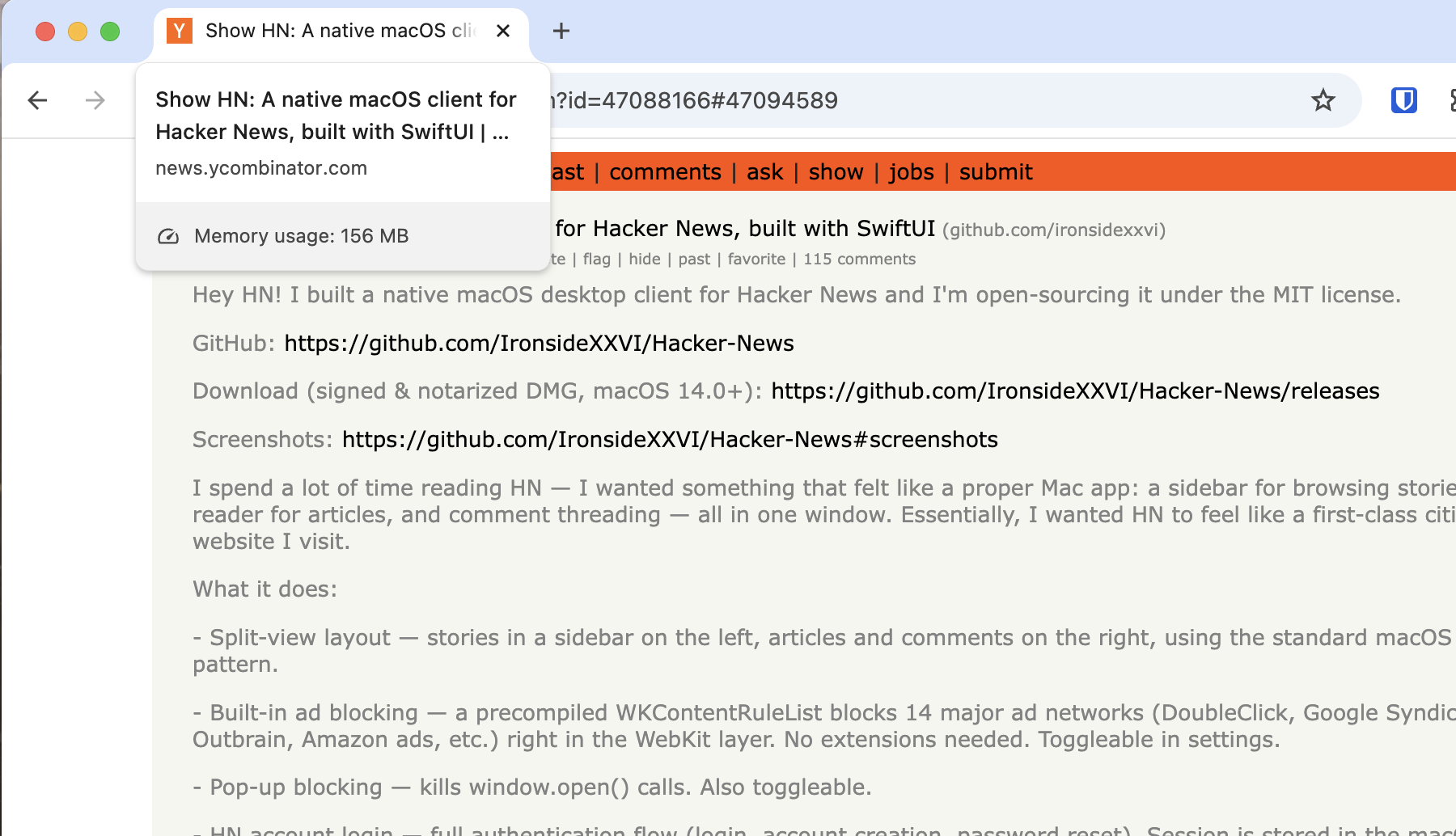
Congrats and building and releasing something. I guess for reading things like this, I'm just a browser kind-of guy. But I still appreciate youre building a NATIVE app that's using around 85MB of working memory (according to my Activity Monotor), and not some Electron thing.
I'm probably just a anti-app guy, but I tried it out.
First thing I went to do was CMD-F to search for some strings in the comments section.
Actually, the real first thing I did, was click on the left-side article preview on the text that said "1 hr ago | 63 comments" thinking it'd navigate me to the comments. See, I like my native hyper-links.
I've never understood the concept of an app wrapper for a link aggregator (HN, reddit, etc). The whole goal is to provide links to external sources, and now I'm browsing the web in a limited web browser without all my extensions etc.
Am I missing some core concept here? Why would I want to browse the web in this app as opposed to a web browser?
Sometimes I like to save the links and comments I find particularly interesting with the "favorite" button, though lately I've debated saving them somewhere else too with a more complicated setup that could also archive both the links and the comments.
As someone who used to use native RSS readers a ton back in the day, the limited web browser usually isn't a problem for just reading a few articles.
I like native apps for things, even link aggregators, because my I want to use my OS's native window management and app management instead of just shoving everything into a browser tab, of which I already have too many. Because then it's just CMD+Tab to Chrome, and then figure out which of the 20+ tabs I'm trying to get to instead of CMD+Tab directly to that specific app.
Anyway, just a bit of old man yelling at cloud but I've always disliked the proliferation of "web app all the things." Might as well not even use a desktop OS at this point and just have a full screen browser window and call it a day.
I'm trying to understand your position here. An app with it's own way to manage multiple browser windows is better, because you have too many tabs open in your browser. If you have multiple links open, the tab management is now a problem in your desktop app instead of the browser. If you don't, then you don't have to manage tabs anyway. What does this solve that a separate browser window doesn't, except not having any way to add extensions like ad blockers or tampermonkey scripts etc?
I guess you could make a web app or app clip but I think this is a cool project. would be good to have a theme engine.
Look at NetNewsWire how good a native app of this kind can be. NNW in particular has great shortcuts, like or opening links in the native browser, and read/unread functionality
I usually don't have multiple HN articles open at a time, but I can see how that would just be replacing one problem (too many browser tabs) for a worse problem (too many, now limited, browser tabs).
It's just nice to have HN as it's own app instead of just another tab in a single app. Same reason I use mail.app vs. webmail, native music app vs the web player, etc.
PWAs also solve the problem, more or less, but it is nice to have something native.
Some people love giving up as much customization and control over their software as possible. iOS over Android. MacOS over Linux. Chrome over Firefox. App stores over installing programs yourself. Apps over websites.
There are various arguments for it (better compatibility/cohesiveness, minimalism, less debugging) but it overall seems like the opposite of the "hacker" mindset which makes how much market share MacOS has in the space very strange.
Ironically, most of the app is a webview. The comments just have some additional CSS styling slapped on top of the hackernews website. So you still have an entire HackerNews site loaded at all times when reading comments anyway.
> But I still appreciate youre building a NATIVE app that's using around 85MB of working memory (according to my Activity Monotor), and not some Electron thing.
Well, assuming you have a browser open anyway, you're still using more memory than if HN is running in another browser tab.
In fact, if every website that you use frequently had its own native app, that would use more memory than you're using now.
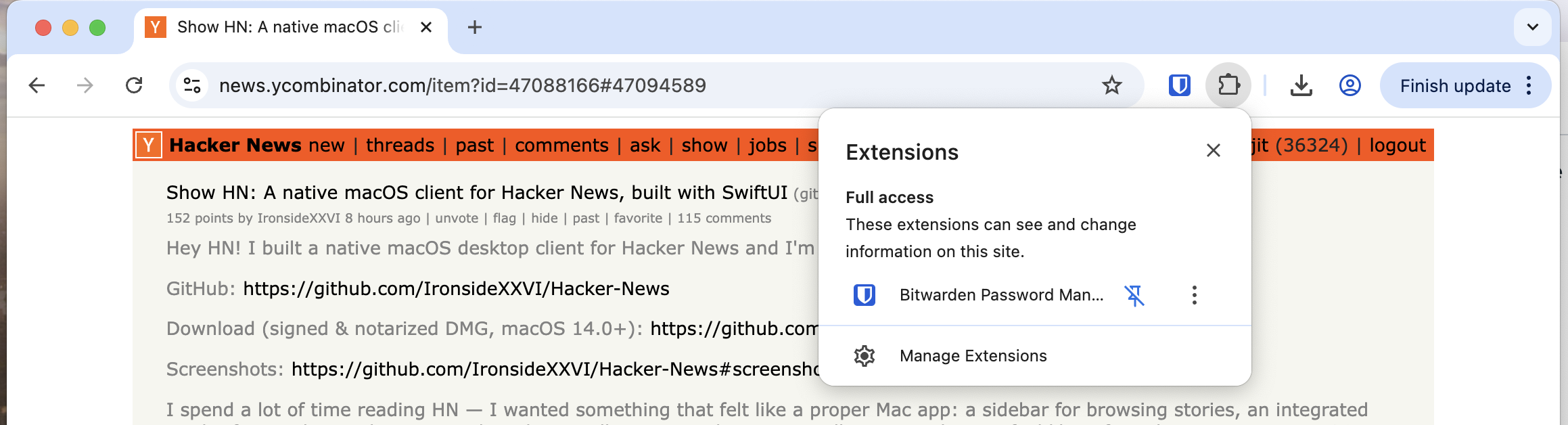
EDIT: Looking into it, seems the tab memory viewer is only looking at the page and does not take extensions into account; if the extensions inject JS/Style to the page then it counts, and Bitwarden seems to only add a small amount of JS to find password dialogues. It uses memory, but outside of the tab viewer.
AI writing will make people who write worse than average, better writers. It'll also make people who write better than average, worse writers. Know where you stand, and have the taste to use wisely.
EDIT: also, just like creating AGENT.md files to help AI write code your way for your projects, etc. If you're going to be doing much writing, you should have your own prompt that can help with your voice and style. Don't be lazy, just because you're leaning on LLMs.
> AI writing will make people who write worse than average, better writers.
Maybe it will make them output better text, but it doesn’t make them better writers. That’d be like saying (to borrow the analogy from the post) that using an excavator makes you better at lifting weights. It doesn’t. You don’t improve, you don’t get better, it’s only the produced artefact which becomes superficially different.
> If you're going to be doing much writing, you should have your own prompt that can help with your voice and style.
The point of the article is the thinking. Style is something completely orthogonal. It’s irrelevant to the discussion.
"You're describing the default output, and you're right — it's bad. But that's like judging a programming language by its tutorial examples.
The actual skill is in the prompting, editing, and knowing when to throw the output away entirely. I use LLMs daily for technical writing and the first draft is almost never the final product. It's a starting point I can reshape faster than staring at a blank page.
The real problem isn't that AI can't produce concise, precise writing — it's that most people accept the first completion and hit send. That's a user problem, not a tool problem."
I don't know if this happens to anyone else but on reading LLM-generated text I did not prompt, my eyes do incredibly quick saccades from start to middle to end in always around <1-2s no matter the length of the text.
It's entirely involuntary, I am just unable to care. It's almost always justified because the text in question is always painfully bloated, and repetitive.
The LLM-text you posted could have been (given I didn't read it carefully):
"Skill issue. Iterate on the output, never accept what you receive on the first pass"
i think a lot of people that use AI to help them write want it specifically BECAUSE it makes them boring and generic.
and that's because people have a weird sort of stylistic cargo-culting that they use to evaluate their writing rather than deciding "does this communicate my ideas efficiently"?
for example, young grad students will always write the most opaque and complicated science papers. from their novice perspective, EVERY paper they read is a little opaque and complicated so they try to emulate that in their writing.
office workers do the same thing. every email from corporate is bland and boring and uses far too many words to say nothing. you want your style to match theirs, so you dump it into an AI machine and you're thrilled that your writing has become just as vapid and verbose as your CEO.
Highly doubt that since its the complete opposite for coding. Whats missing for people of all skill levels is that writing helps you organize your thoughts, but that can happen at prompt time?
Good code is marked by productivity, conformance to standards, and absence of bugs. Good writing is marked by originality and personality and not overusing the rhetorical crutches AI overrelies on to try to seem engaging.
After telling Copilot to lose the em-dash, never say “It’s not A, it’s B” and avoid alternating one-sentence and long paragraphs it had the gall to tell me it wrote better than most people.
Time, effort, and skill being equal, I would suggest that AI access generally improves the quality of any given output. The issue is that AI use is only externally identifiable when at least one of those inputs is low, which makes it easy to develop poor heuristics.
No one finds AI-assisted prose/code/ideas boring, per se. They find bad prose/code/ideas boring. "AI makes you boring" is this generation's version of complaining about typing or cellular phones. AI is just a tool; it's up to humans how to use it.
all the ad blockers I used to use stop working, and it became an annoying game of cat and mouse that I didn't have time for. Luckily, most of the time I can "skip" the ad in like five seconds, and it gives me a moment to catch up on incoming Slack messages.
The only ad blocker I have used for the past couple of years has been uBlock Origin, more recently combined with SponsorBlock.
There has been two or three instances that I can remember when it did not block YouTube ads correctly for a couple of days. But those were quickly patched and it started to work again.
When has ublock origin browser extension ever stopped working?
On a locked down mobile OS like iOS you can use the Brave browser.
No cat and mouse game.
One day I visited DistroWatch.com. The site deliberately tweaked its images so ad blockers would block some "good" images. It took me awhile to figure out what was going on. The site freely admitted what it was doing. The site's point was: you're looking at my site, which I provide for free, yet you block the thing that lets me pay for the site?
I stopped using ad blockers after that. If a site has content worth paying for, I pay. If it is a horrible ad-infested hole, I don't visit it at all. Otherwise, I load ads.
Which overall means I pay for more things and visit less crap things and just visit less things period. Which is good.
Moreover you don’t even need a 0-day to fall for phishing. All you need is to be a little tired or somehow not paying attention (inb4 “it will never happen to ME, I am too smart for that”)
At $JOB IT actually bundles uBlock in all the browsers available to us, as per CIA (or one of those 3-letter agencies, might've even been the NSA) guidelines it's a very important security tool. I work in banking.
I do that as well. For me it is almost exclusively the case with the news sites.
> If it is a horrible ad-infested hole, I don't visit it at all.
Same.
> Otherwise, I load ads.
There is no "otherwise" for me. I simply do not want to load any kind of ads or "sponsored" content. I see no reason, either moral, ethical or other, to ever do that.


Clear production vision that you're building the right thing in the right way -- this involves a lot of taste to get right. Good PMs have this. Good enginers have this. Visionary leaders have this....
The execution of using AI to generate the code and other artifacts, is a matter of skill. But without the taste that you're building the right thing, with the right features, in a revolutionary way that will be delightful to use....
I've looked at three non-engineer vibe-coded businesses in the past month, and can tell that without taste, they're building a pretty mediocre product at best. The founders don't see it yet. And like the article says, they're just setting themselves up for mediocrity. I think any really good PM would be able to improve all these apps I looked at almost immediately.
reply