Breville coffee grinders are impossible to get internal parts for. I designed a 3D printed upgrade for the main wear-part in their BCG800XL and BCG600SIL Grinders.
The storefront is through ShapeWays[1] and I use iFixit[2],[3] to drive the traffic. It passively makes enough to cover my own coffee needs forever. I spend about 20 minutes per month fielding questions. This all happened because my grinder failed and I could not get parts.
I use a super cheap hand grinder I bought off amazon (the stainless steel one that there are 100 different variations of on amazon). There is a plastic part that breaks after about 6 months of usage. Someone modeled and uploaded a replacement piece to Thingiverse. The grinder is cheap enough that it is disposable, but since it is so easy to print a replacement piece with my $179 3D printer, I haven’t needed to throw it away. I hope that at some point 3D printing becomes more accessible and affordable, and with more materials, that more and more products are repaired instead of replaced.
It's quite toxic. It causes cancer among other problems. A lot of things used to be Cadmium plated because it's an excellent rustproofer. Some things in the aerospace world still are, because for some things, the safety risk from corrosion outweighs the health risk.
It's not a great idea to grind or sand Cadmium plated items, because it kicks the Cd into a fine dust that you will inhale and will be absorbed into your system.
So far I only brushed it, and am not sure my model is Cd plated or not but well. The more you dig into materials, the more you realize you were handling toxic things all the time without knowing it.
My father-in-law as a kid used to go to the junkyard and break open thermometers and dump the mercury out into his hand. Seems like he did it a lot. Dunno if he ever suffered any health consequences because of it; but, you know, he didn't know any better. He just thought it was neat.
Your father-in-law wasn’t in any great deal of danger. Thermometers used elemental mercury, meaning pure mercury that hasn’t reacted with anything. The only real risk from elemental mercury is that it has a low vapor pressure, and can therefore be inhaled, which can be dangerous. Since your FIL was outdoors, the risk of vaporization was high, but risk of inhaling a concentrated amount was low. Had be been doing this in, say, a tool shed, then the danger would have been much greater.
The kind of mercury you hear about that is incredibly toxic and can absorb through your skin are actually mercury salts (ethyl mercury, methyl mercury, etc.) and aren’t as likely to be found.
The other day i accidentally broke a magnetron ceramic heatsink. I knew of the potential toxicity (disassembled a dozen so far) but this time i fucked up. Cue 3 days of ventilation and cm by cm wet cleaning.
Metal on metal knee and hip joints replacements contain cadmium. It can ruin your life. If you want to see a good documentary about problems with modern medical devices, check http://bleedingedgedoc.com/
Another random datapoint. I have been using a Monoprice MP Select Mini V2 [1] for a couple years (similar price point) and am extremely pleased. After leveling the bed the first time I've done no maintenance and it seems to print when asked with no trouble. I typically use it not at all for a few months, then up to multiple times a day when working on something.
I've helped a friend with this one (I have a MP Select V2 full size), and I can tell you the thing is a workhorse. Pretty sure he has it running 5 days a week with 5-7 hour prints per day. He keeps the moving parts lubricated but that's about it. Just set him up with Octoprint to make the loading and monitoring easier.
I recently ordered a part for my daughters dresser drawer - the Kenlin Rite-TrackII, and paid $12 for four including shipping. 6 to 7 years ago I paid $68 for a single part. To my surprise when I opened my recent plastic mailer envelope, I discovered it was a 3D printed piece. Any idea how one can 3d scan a part for exact copy?
They make full on 3d scanners but most parts do not need "3d scanning" so much as they need a few minutes in the hand of someone with a caliper and a sketch pad.
The field of photogrammetry deals with taking multiple photos of something to create a 3d model. There is free software for consumers that can do this. But there are a lot of limitations and currently the traditional way of making a CAD model more or less by hand is almost always faster/cheaper and more accurate.
There are a few services including Autodesk ReCap which you can give a number of high quality photos and a 3D model will be produced which you can then scale appropriately in your CAD software
For most things scanning works pretty poorly. IME, you are better off you use some calipers and a free to use tool like Fusion 360 or TinkerCAD, or a really free tool like OpenSCAD to generate the model.
I know a guy who runs a multi-million dollar business making replacement parts for a particular type of business machine that you find in a lot of places. There are only a few OEMs and they all stopped making a similar (critical) component for their older models.
He was originally in the business of repairing these machines and then discovered he could no longer buy these parts from the OEMs so he learned CAD and CNC and injection molding and started making them a few years ago. He has a 3D printer for prototyping, but he needs to injection mold part of the final product because there is no filament in the particular material that he needs. His business has transitioned from repair to manufacturing and now he mostly sells replacement parts to other repair shops.
I don't want to disturb his business by talking about it in detail, but the point is that I think there are and will be many opportunities around repair parts that manufacturers are unwilling to provide because they'd rather be selling new machines. Aside from the environmental impact, that's fine since there are many people who won't go the repair route, and then there's a secondary market for those who will make parts and repair the machines.
I used to know tool and die makers that did that back in the day. Sadly, a lot of manufacturing was sent off to China. I assume there are Chinese people doing similar things.
I'm willing to bet the quality of a lot of these is shite, though. Plus people in the US would most likely want to buy from a seller in the US (faster shipping + implied better quality).
There is a solution to so many problems here (creating usually unavailable parts for machines/devices/products) but the problem is knowing which parts are in demand and currently have no supplier.
A maker would need to have an interest or hobby in such a device & discover a need for the item for it to come into fruition. But just think of how many general 3D printed parts could be printed as solutions for so many products out there that are going unmade.
Not all Chinese stuff is bad, but there's so much bad stuff that it's hard to know what's good. "Chinesium" is an accurate description of the situation.
In the case of American-made products, it's easy enough to do the research to determine if a product is good, or even try it before you buy. I don't know how good Chevys are these days—the newest one I've driven is a 2005 truck—but they're a known entity and you can test drive one for free. Ordering something online from China is a stab in the dark.
I would like to if time permits. There is a huge untapped market here. The difficulty is in locating the parts that are both unavailable and 3D printable. I keep it in the back of my head as I repair other items. So much expensive stuff ends up in a landfill over a tiny part.
I could see someday having a github project for replacement parts, each one iterating and getting better an better -- far beyond the original.
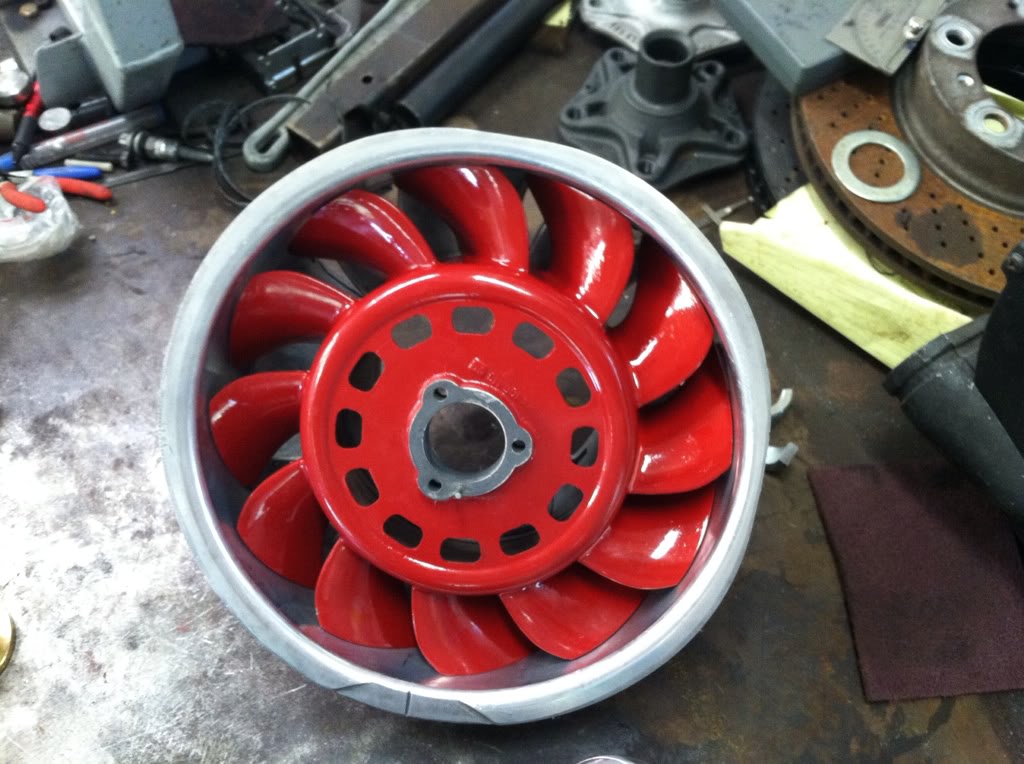
This. A friend buys and restores old Porsche 911s. He will pay anything for custom made parts that are rare as hens teeth. As an example there is a housing around the main cooling fan that seems to be titanium or aluminum or something very exotic. [1]
A company does sell a replacement, which he paid a fortune for, which had garbage tolerances and we spent weeks modifying it until it fit more or less well enough.
I suspect if you spent time on "classic car" forums you'd find owners of very specific models of cars searching for things you could make and sell for any markup, and every owner would buy one.
I am into older Maserati's. Own a couple of them. I do a lot of manufacturing myself. 3d printing, cncing. The problem is that whenever I design a replacement panel, wishbones or various other stuff and try to sell them commercialy I will get sued by the original Maserati company. On a low scale it's fine, but you will never get a living out of it.
The only parts which are in a gray area are rims, exhausts, filters, springs and couple of other parts.
What do they sue you for? If you are upfront about what you are selling, and you didn't steal any IP, it isn't fraud or theft of trade secrets. Maybe they have patents, and claim you are violating them? I can't see how it is illegal to reverse engineer a part and sell a similar version.
Similarly, a German-based company started producing replica Mercedes 300 SL bodies but they were shutdown and the bodies had to be crushed. Although, this isn't quite the same, because the bodies weren't used as replacement parts to keep existing cars on the road.
If we had a right to repair law, presumably it would allow third parties to make replacements when the original manufacturer lo linger was.
Even without that, I'm kind of surprised they sue. Are they patenting each part? Is there case law that covers this? Or is it just a case of bringing a suit to scare people I sto stopping? I wonder.
I would actually like to hear a little more about why the tolerances were poor. Were the major diameters the issue here? I could see a lot of adjustment happening on a car-to-car basis to get concentricity between the alternator fan and the shroud just right. I have very little experience with Porsches, but am a coordinate metrologist for a major aerospace parts manufacturer. I don't see something like this being a huge issue, at least compared to what I deal with on a day-to-day basis.
Edit: I actually looked into it a little more- it looks like the part is probably machined from casting given that there appear to be four stators which also locate the center mounting point. That's where the concentricity would be set; not by the casting, but by the machining of the center flange. So assuming that the fan's mounting points are within spec, I would say that your friend's part could just be chalked up to machining process that leaves something to be desired. This is actually a trickier part if machined from casting (without the appropriate tooling), but actually pretty simple (and wildly expensive) if machined from billet.
Probably some entrepreneur ordering them in small quantities from China from a place that makes frying pans one day, car parts the next.
I used to order a lot of custom things from China. Took a lot of trial and error to find good suppliers. They only accept bank wire as payment, so they risk little other than repeat business if they choose to be sloppy.
You're right, it was a cast part that had been machined, and (from memory) the machining was not precise enough to locate the alternator (and thus the fan) in the exact center. It kind of seemed liked a backyard job, but the price was anything but.
I think from memory the inside of the circle (which was cast) was not perfectly round. From memory the original Porsche part was titanium, and this replacement was aluminum. But I might have that backwards.
It doesn't surprise me in the least that circularity on the casting would be messed up, you would just think that the person on the mill would have the presence of mind to take a look at it before sending it off to the end-user. We reject castings pretty regularly, and that ID could be turned true without a great deal of difficulty provided the deviation in roundness didn't exceed something like 1/2 material thickness.
What doesn't sit right with me is the fact that for a small run, the price of even an aluminum casting would absolutely motivate me to get it right the first time. At the level of volume that the guy would have to be operating at, I would be test-fitting every part to a car before sending it out the door.
I feel like the relative scarcity of air-cooled 911s coupled with the difficulty of machining the part correctly as a third party is why the part itself is so hard to come by. If a person were motivated, though, there is definitely another way to make a suitable replacement more cheaply and easily with a modified design. That's provided someone is okay with not having a completely factory 911.
A 5 axis mill? Once you had the model you could get one offs in many contract shops. It is by no means trivial but if it is an expensive part you could make a very workable copy. Given the required characteristics of the air flow there are some programs that calculate blade profiles.
Maybe the part would end up even more expensive but that sounds like an interesting and worthwhile project.
I do this for old (15yrs+, not old-old) JDM cars. There's a massive untapped potential in this for any car-nuts who have 3D printers.
Just take a quick look through your favourite forum for your car of choice and there's endless threads begging for some random old plastic part that can no longer be found.
Interior trim clips, centre console fascias, exterior body plugs (where tow hook goes, where roof racks go, etc), stereo surrounds, door handle surrounds, etc etc etc.
Depends on your pricing and margins. There's a huge number of parts that are available but ridiculously priced, often coming out an order of magnitude in excess of what seems reasonable.
Take for instance a kettle scale filter. OK you probably can't 3d print these, but for something so simple they're insanely priced - £5-£15 for a bit of plastic. A whole kettle with filter costs typically £15-£35. Dyson parts are even sillier.
After material costs, time, shipping, advertising, & customer support, how much margin do you think there is to make on a part that already sells at £5-15 (ESP in an environment where spending £15-30 to get a new one is an accepted norm already)?
This is def not viable from my view- at least not for parts that are this cheap already.
lol. 99% of it is margin - it's 50% of the whole retail item cost for <1% of the material or complexity.
That's most of it left for promotion. Domestic appliances, large and small, regularly have small spare parts that attract 25 or 50% of the price of the entire item. Never used to.
That they're already doing well with small appliances in the niche of non-available parts says enough about pricing floor.
All plastic parts for appliances: dish drawer wheels, fridge shelves - are all designed to not last, run for $$$ on vendor site if possible to find at all. If you print it - they would come.
I recently had to replace the side wheel motor assembly on a Roomba. The motor and housing were fine, but the gears inside had worn out. I think they were just made out of ABS, so if they were printed in Nylon they would be a lot longer wearing. Roomba do make their robots (at least the 620 I have) repairable and a replacement of the whole assembly was only £20 so I'm not sure if the margin is there, but it is a bit wasteful when the only issue was the gears.
I've also considered creating some upgrades to the stock parts, but it's on my "some day I'll get around to it" list.
The hard part is finding appliances that need fixing. This is super easy if you happen to own a lot do things that break. If not, it becomes quite boring and tedious to scout out things that are breaking for other people, that you have no personal motivation to fix, to get the broken appliance and then figure out the 3d model for the bad part.
It's a neat business model: The person posts DIY repair videos on youtube, which drives traffic to his site. The strollers can easily cost $1000 new, and are often handed down / resold, so there is motivation to keep them running, and they have some weak spots which tend to break. The 3D printed replacement parts can be of superior quality to the original parts.
It seems like once you build up a critical mass of reputation/SEO you could get people to send you their broken parts to reproduce (then start advertising that specific part too)
Then that depends on either how much they're paying for the part and how much you enjoying 3d modeling and the trial and error dof 3d printing. You'll also need at least a real version of the part to copy and maybe even the appliance.
If you buy a bag with rollerblade wheels vs the plastic castering garbage that comes on a lot of bags you’ll get significantly more life out of them. I spend 15-20 days/month on the road and get several years out of rollerblade wheels.
are you concerned about the low amounts of ground nylon that your customers (or really the original customers) were ingesting if this part does wear down over time?
PA2200 Nylon is not water soluble so any particles would stay with the discarded grounds. It’s pretty harmless stuff anyway. Breville’s version wears fast but the ShapeWays one has held up really well. Check out the two year wear study on the ShapeWays shop page; I am really happy with how minimal it is.
Aah I wasn't thinking it through. I guess as long as the fragments are caught in the filter during the coffee making it's likely fine. And for some reason I forgot that coffee is essentially strained/filtered. I have a jura and so I just press a button and it goooooess.
If OP is selling via Shapeways, it's printed and shipped by Shapeways in the user's choice of material. From the link, it looks like the only option for this one is Nylon, but that's about the strongest plastic you can get for things like gears.
Not necessarily suggesting it for this, but for anyone not used to shapeways they have a wide range of materials, with plastics of different types, metals (I have silver wedding rings I got printed there) and ceramics.
I think sellers may be able to limit the materials to known working ones (each material has it's own requirements).
The goal was the unique design, but they were cheap too for wedding rings. I recorded each of us saying something to the other, then took the waveforms and made a ring from each one. Printing came to about £40 for each ring.
> is there any way to scan it from your phone and hear it?
It's not detailed enough for that, though you can tell the cadence and reliably guess at the number of words. If you know what we said, and only we do, then you can see it.
If you take a look at the shapeways page OP links he mentions that the nylon material is technically not rated food grade due to it being slightly porous. This can cause particles of the food to stick in the holes. He mentions it's not much of an issue with coffee since that just means some stale coffee, however I imagine it might be more of a problem with milk. It looks like shapeways has a variety of material, however.
Had a Breville expresso machine I repaired multiple times for my wife. The pump was decent, but the electronics were complete garbage for a $500 machine. The main problem were unsealed switches in a humid environment.
If you are someone that drinks no more than 1-3 cups a day, then I see no pointing getting an electric grinder over a higher-quality manual grinder, like the Comandante C40.


The storefront is through ShapeWays[1] and I use iFixit[2],[3] to drive the traffic. It passively makes enough to cover my own coffee needs forever. I spend about 20 minutes per month fielding questions. This all happened because my grinder failed and I could not get parts.
[1] https://www.shapeways.com/product/NASLAGCCP/breville-coffee-...
[2] https://www.ifixit.com/Guide/BCG800XL+Grinder+Jamming+due+to...
[3] https://www.ifixit.com/Guide/BCG600SIL+Dose+Control+Pro+Coff...