> For the people (families with young kids) that are most in need of a car, the average occupancy is much higher.
But obviously they are dwarved by the single commuters, or else the average wouldn't be 1.4 persons per car.
> So light rail/commuter rail is more efficient than an electric car when you assume that the car is single occupant and the light train is fully packed. That is a way of tipping the scales, but not an honest argument.
Let's look at the numbers again. To not disadvantage the car, we assume 20% capacity, which is the minimum possible for a car.
A single instance of the named train at 20% capacity accomodates 100 people while needing 2400kW. A single Tesla at 20% capacity accomodates 1 person at lets say 175kw if it is model 3. That is 24kW per person for the train and 175kW for the car. A factor of 1:7.
To reflect the real world data, we'll assume 1.4 persons per car from the souce above, which would mean a capacity of 28%. The train equivalent is 140 persone, meaning a factor of a bit more than 1:7 in favor of the train.
In my area the actual train during communiting hours is at least 70% occupied, BTW.
I'm not trying to win internet points here; there just is no way around the fact that electic cars are not in any way a meaningful solution to our climate problem.
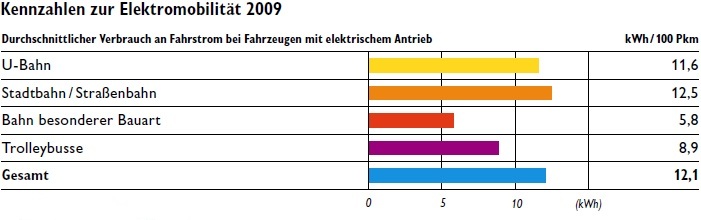
So a subway car or a commuter rail car gets 12.5 kWh per 100 person kilometers. That is still better than a tesla model 3 of 160 Wh / km or 16 kWh / 100km. But not by much.
If you assume 1.4 people on average, you get 11.4 kWh / 100km / person, so basically the same.
And if you have 3 or 4 people, the model 3 is significantly more efficient than the average commuter rail.
> In my area the actual train during communiting hours is at least 70% occupied, BTW.
But trains also go outside commuting hours. That is the whole problem with a system that has large units and is not on demand.
> I'm not trying to win internet points here; there just is no way around the fact that electic cars are not in any way a meaningful solution to our climate problem.
Neither am I. I was doing back of the envelope calculations about what it would take to do a battery powered commuter rail for the relation I frequently use, and was genuinely surprised how inefficient commuter rail is on average.
It would be good to have figures for trains that are up to 10 years old (rather than everything up to 40 years old or whatever), which should be more efficient, and the manufacturing energy cost for the vehicles -- I suspect the cars will fare quite badly here.
We can also take into account the cost of accidents, which we could probably assign an energy value to avoiding.
Where are you getting 175kW for a Model 3? A standard model 3 uses 25 kWh per 100 miles according to [1]. If we assume it is traveling at 50 mph, that is 12.5kW continuous
Yes, I have misremembered the power, which seems to be 211 for most models. You are quite correct that it would make more sense to compare actual usage per distance, but I couldn't find this number for a train, so just compared the motors itself.


But obviously they are dwarved by the single commuters, or else the average wouldn't be 1.4 persons per car.
> So light rail/commuter rail is more efficient than an electric car when you assume that the car is single occupant and the light train is fully packed. That is a way of tipping the scales, but not an honest argument.
Let's look at the numbers again. To not disadvantage the car, we assume 20% capacity, which is the minimum possible for a car.
A single instance of the named train at 20% capacity accomodates 100 people while needing 2400kW. A single Tesla at 20% capacity accomodates 1 person at lets say 175kw if it is model 3. That is 24kW per person for the train and 175kW for the car. A factor of 1:7.
To reflect the real world data, we'll assume 1.4 persons per car from the souce above, which would mean a capacity of 28%. The train equivalent is 140 persone, meaning a factor of a bit more than 1:7 in favor of the train.
In my area the actual train during communiting hours is at least 70% occupied, BTW.
I'm not trying to win internet points here; there just is no way around the fact that electic cars are not in any way a meaningful solution to our climate problem.