Powerlight technologies(formerly LaserMotive) has demonstrated power over fiber tech that can transmit hundreds of watts[0][1]. The intended application of this tech was for powering underwater remotely operated vehicles(ROV). The same amount of power could be transmitted with a thinner fiberoptic cable than a copper cable, so it would encumber the ROV less. Although other niche applications like powering electronics in regions with EMP or near MRI's were suggested. Powerlight's linkedin currently shows them powering an inflatable christmas decoration with power over fiber.
Some of the people at Powerlight found this tech to be ironic because Powerlight was originally founded as a wireless power beaming company. However, some of their customers asked if they could transmit power via wires, so that's what they did.
Thats super cool for the ROV aspect. In university I was part of the underwater robotics program, and optimizing the tether was a huge aspect. We used a fiberoptic line for communication, leaving the rest of the cable mostly dominated by the copper conductor for power.
Any weight reduction that can be made for the cable internals is actually two fold. The cable needs to remain neutrally buoyant as to not pull on the ROV and not restrict the pilot. Less internal weight in the cable means less foam/other material needs to be added to offset the negative buoyancy.
Would I be right in thinking a tether would be necessary with a ROV for a high bandwidth live video link as ultrasound seems only usable up to 100s of kHz.
I guess the only high bandwidth alternative might be lasers?
Really bright LEDs can be used for underwater optical communication up to 100 m[0]. I'd really like to see someone make this tech into an FPV system for RC subs.
>>LEDs can be used for underwater optical communication up to 100m
Maybe in the clear open sea of the Caribbean. Not all water is perfectly clear at any wavelength. I give it something more like 100mm through turbid river outflow.
It'd be kind of sketchy to have as a single point of failure in an underwater ROV that might not be able to emergency-surface straight up (e.g. wreck or overhang exploration).
There's a ton of gnarly stuff that can happen underwater acoustically without obvious warning (salinity, temperature, topography, etc etc).
Wireless signals can drop off very quickly even in clear water. Add dirt, algae, turbulence, etc to that and it quickly drops off in about a meter for reasonable devices. For our bot we had about 3 1080p video streams being sent back over the wire, which requires a decent amount of bandwidth (we used a small fiberoptic ethernet switch on the surface and inside the enclosure).
Apart from that, if your ROV is light, and the cable is durable enough, the cable can make for a good retrieval method when you brown out the bot haha.
I call bullshit on the claim that you can transfer as much energy through optical fiber as through a copper wire of the same width. I'm pretty sure they calculate the power transmitted taking into account only the 'active' part of the fiber, its core which diameter is in micrometers. So it's akin to pretending that to transfer electricity you just need copper core without the insulators
I suspect their statement is true if you consider the fully-loaded diameter too -- i.e. fiber + cladding can carry more power than copper + insulation, especially for small gauges.
Edit: Quick google... This paper [1] shows a 180um fiber + cladding carrying 150W over 1km. According to [2], that diameter equates to a 33awg wire, which has 678 ohm/km resistance and a maximum current of 0.072A. At 1km, the wire would be 678ohms. For maximum power transfer, you want the load to equal the resistance of the wire. Thus you could deliver 0.072A into a 678ohm load - i.e. your maximum power would be 3.5 Watts. The fiber is better by 40x.
Your maximum current is too conservative, power transmission calculations are conservative enough to run wire through fiberglass insulation in a hot attic. Closer is "chassis wiring" which rates that wire for 0.47A: https://www.powerstream.com/Wire_Size.htm
To deliver 150W with output voltage of 300V (0.5A) would require an input voltage of 640V at an efficiency of ~45%. Not great. The water could handle a lot higher heat distribution but efficiency is already terrible.
You’re right, though I suspect you could increase that “max” current figure quite substantially if we’re assuming this is an underwater ROV and the wire has water cooling for free. You’d need to be pumping a whopping 300A/mm^2 through that wire to match the 150W fiber, though, so your conclusion isn’t affected.
Also, your calculation is for equivalent diameters. If mass was more important then, well, the fiber is 1/3 the density of copper…
Remember, that power is voltage times current. You can increase voltage to push as much power as you want through any wire. This is the reason why overhead lines use such high voltages.
Now, the limitation is the insulation of the wire. The insulation will determine how high voltage you can use and when you increase voltage, the insulation requirements grow very quickly.
The fiberoptic can transfer more power, just not for the reason you think it can.
That's right and since we are talking about ROVs, I recall that it is common to power the ROV with relatively high voltages specifically to allow for smaller and lighter tethers.
It's been a long time since I did any physics, but explain to me why you can't run the 0.072A into e.g. a 10kohm load and have 51W of power dissipated in the load? Sure you'd be running at several hundred volts, but high voltage is how you get more power through less copper.
[edit]
Upon further reflection your claim about maximum power transfer being when the load and cable are dissipating the same total power doesn't pass the sniff test, because it would imply that a load connected by the same 33awg cable, but only 1m long could only drive a load of 3.5mW since the load would then only be 678 mohm.
For other's curious: the "load resistance matches source resistance" is true for maximum power transfer of fixed voltage sources. In the case of current capacity of a wire, the voltage is variable, but the maximum current is fixed.
In that case we are selecting the input voltage for maximum power so (Rs, I are fixed, Rl can vary, and for a purely resistive load, Vin is a function of Rl):
  Vin=I(Rs+Rl)

  Vin = Vs + Vl

  Vl/Vs=Rl/Rs

  Pl = (I^2*Rl)
Clearly we can always select a Rl (and thus a Vin) that gets the desired Pl at a fixed current. Obviously at some point we are limited by shielding of the wire, and DC/DC conversion at the end-point. We eventually may also be limited by interactions between the medium surrounding the wire and EM fields generated by turning the circuit on and off. But, when you can control the voltage, there's no simple calculation from wire impedance to X maximum watts of load.
Nah, just google 'high power fiber cable', these are used to transfer light in laser steel cutters. As these are already in practical, industrial use we can assume that their spec is in line with what is currently realistically achievable for an optical fiber power transmission over a distance of a few meters max. For instance a SMA905 Fiber Cable can deliver meager 50 Watts and its external diameter is 5 millimeters which is laughable low compared to how much power you could push through a copper cable with the same external diameter, that is including electrical insulator.
I don't think it's a reasonable assumption to look at industrial use cases over small distances compared to long-distance operations -- the design criteria are different.
The design criteria is exactly the same. Have an optical medium with as little attenuation as you can. If you can't have it in a medium that is only a few meters long how could you possibly achieve it in a medium of a few kilometers? Apply your logic to copper cables. Can you have a copper cable able to deliver power over a long distance but unable to deliver the same power over a shorter distance?
There's absolutely no reason for the application you cited to optimize diameter and isn't approaching physical limits.
There's no reason you can't shove many optical fibers into that 5mm diameter. People don't, in short distance applications, to have simpler systems and connectors.
There's big reasons why we don't use power over fiber (the endpoints are very expensive, and the overall system efficiencies are low). None of them have to do with the highest optical power density you could hit.
The analogy doesn’t hold because one of the hardest parts of this technology is building a device that can extract the optical energy as electrical energy, and dissipate whatever heat it generates. The power density of the fiber itself is easy by comparison.
The analogy holds perfectly. Remember, we are discussing a claim that optical fiber with all required cladding/protection can carry as much power as a copper wire with all insulation having the same external dimension as the fiber cable. It is simply not possible, fiber will always have less power carrying capacity and your claim that fiber power density is 'easy' has no basis in the reality.
> The design criteria is exactly the same. Have an optical medium with as little attenuation as you can.
If the design criteria for cables was "make a good cable", we wouldn't have thousands of different types. There are cables which have different mechanical and environmental properties, different cost constraints, prioritization of different performance characteristics, etc.
> Can you have a copper cable able to deliver power over a long distance but unable to deliver the same power over a shorter distance?
Depending on the particular application, yes. Consider some 12/2 solid Romex. It'll handle 10 watts just fine, for quite a distance, if you want. Won't work well for a 1 meter long phone charging cable, though. Different mechanical requirements.
I know things kind of derailed downthread from here, but I just have to add that your claim is either confusing or simply untrue. I visited a manufacturer of industrial laser welds [1], and they use 16 kWh lasers over reasonably small fibers. I don't know the exact dimensions, but the overall cable looked like… a reasonable cable. Somewhere like 10 to 25 mm perhaps?
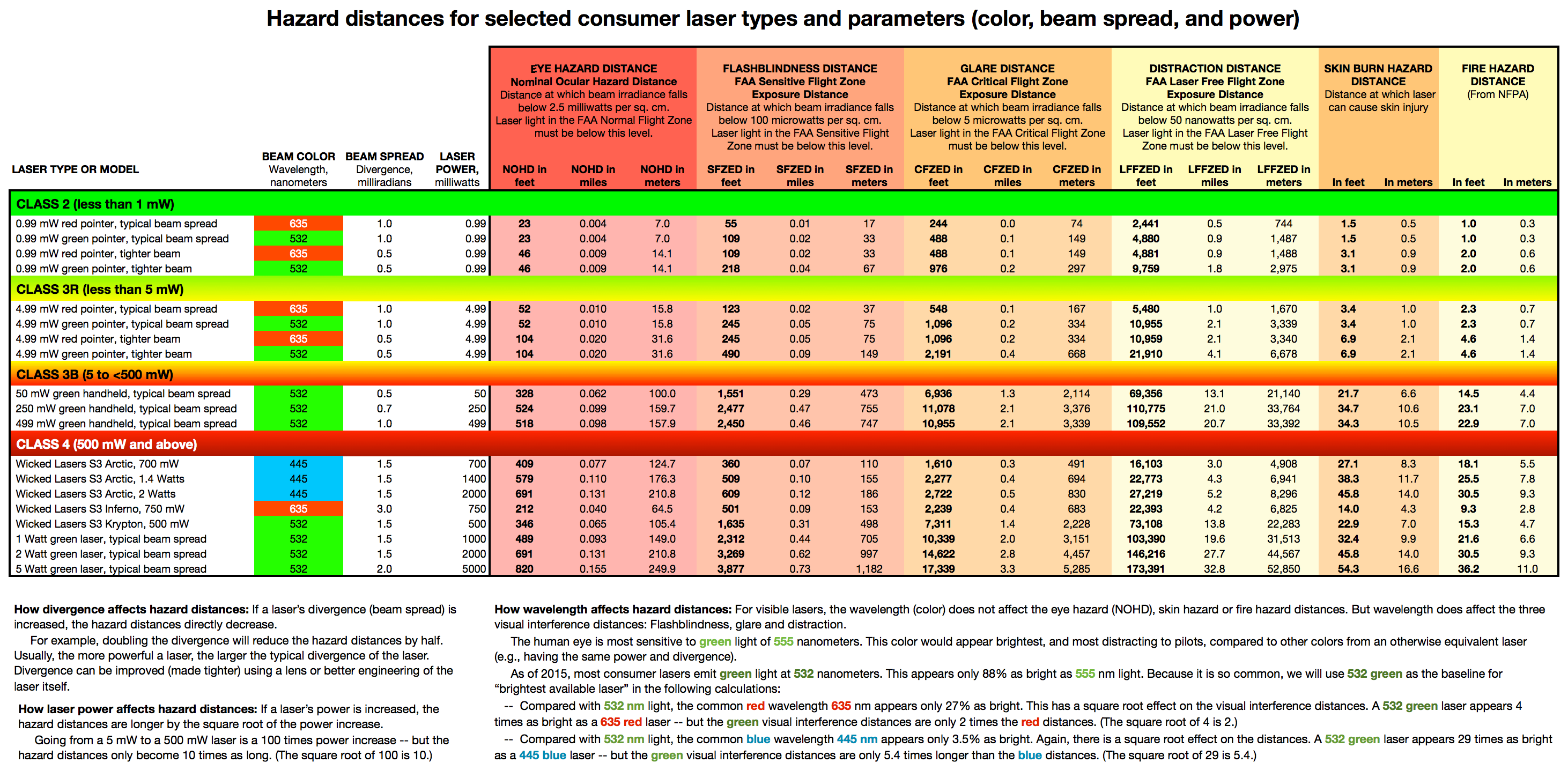
That chart is for collimated lasers. There is nothing especially inherently dangerous about laser light, and 1.5W or so of light is common (your average household ceiling light is in that ballpark). A fiber break is a point source (more dangerous especially at very close range) and is a bit focused, but it’s not going to burn holes in your skin or cornea at any appreciable distance. If it’s a wavelength that penetrates to the retina, then maybe the fact that it’s a point source will make it more dangerous if it’s in focus.
What does looking at a laser have to do with being safe from a class 4 laser? You could be two rooms over and be blinded by it if there are specular surfaces (which there usually are).
This is definitely not a most common transceiver, which is the point of all the commentary.
I'd refuse to buy this thing unless there was some national security reason for doing so, and then there would have to be interlocks on the room to de-energize it when anyone entered.
They are class-1 only because the system is designed to not have any light visible during normal operation. Interlocks can be the only difference between a class-1 and a class-4 laser.
General rule of thumb: if it's been banned, it's useless for the signatories. Ex: chemical weapons, but also biological weapons, land mines, and cluster munitions. Note that land mines and cluster munitions are still actively being used, especially in Ukraine, and the countries that signed onto the ban largely got rid of those systems well before the ban was signed.
It has. That's why countries don't have real chemical weapons anymore. They are easy to make (for an industrialized country), but they don't provide any real advantage when both sides in a war have access to them. They just increase misery for everyone involved.
The argument I've seen against their usefulness is that they only work against static militaries that don't have NBC training, and a modern military can already defeat threats like that without paying the political cost of using them.
They're not. They're effective against an unprepared adversary. Any real military will have anti-chemical-weapons tactics and protection.
So this happens: you douse a building with a gas, and then walk inside and get shot by defenders in gas masks. And by the way, you also will have to wear a gas mask yourself.
Still need a major supplier both the laser emitters and esp. the optics. The weapons will be a lot more expensive compared to conventional weapons, or any anti-riot weaponry.
Aside the sci-fi vibe, I could imagine James Bond esque - still quite hard to use, has to aim for the eyes, scatter can cause collateral damage, doesn't work in fog, rain, etc.
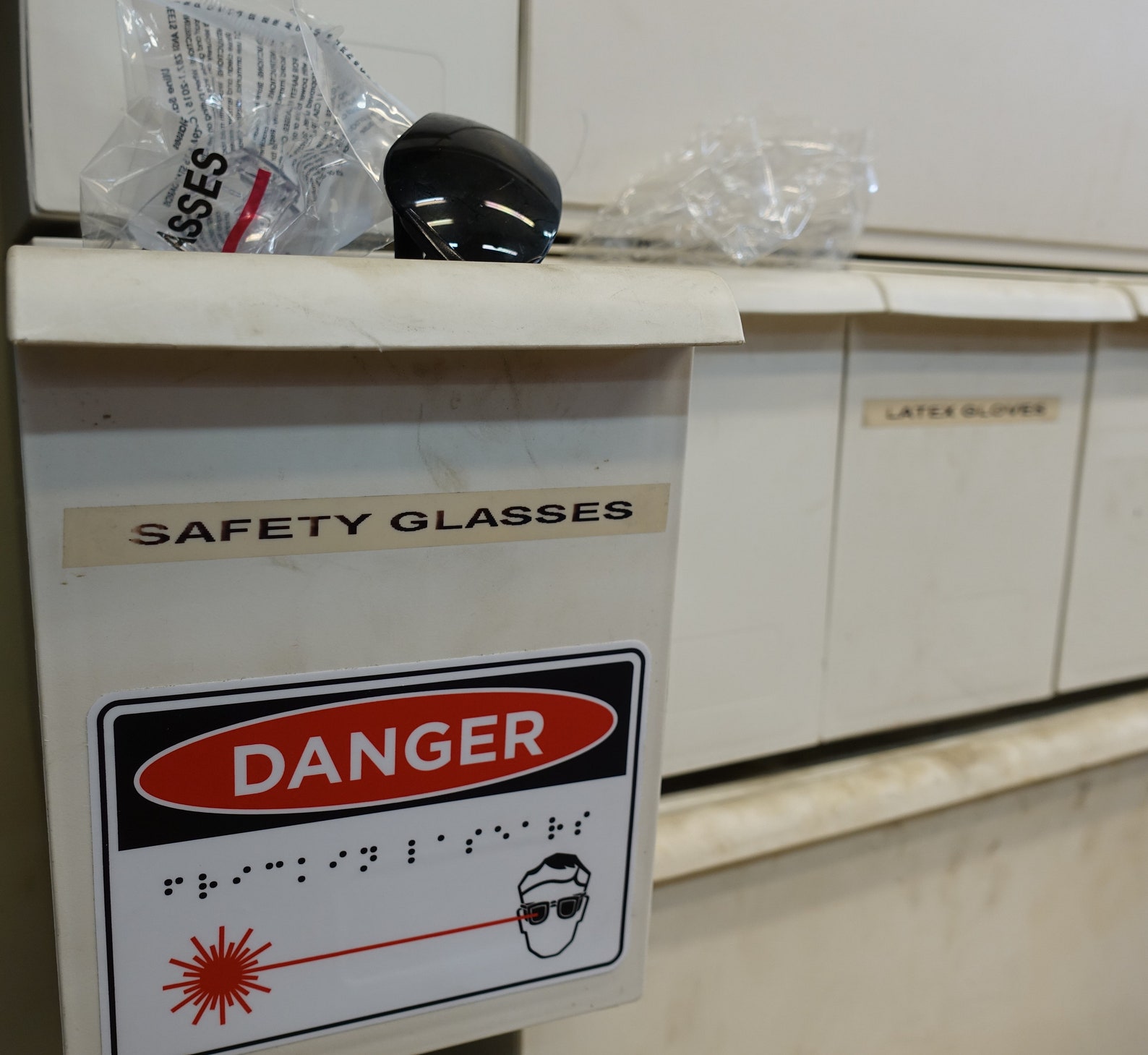
It's tongue-in-cheek, implying that many people working with the stuff already lost an eye to it.
It's part joke and part telling people "hey, this stuff is really dangerous, take it seriously or you'll lose an eye, or both". I don't think I've seen a single lab with high-powered lasers that didn't have a variant of this sign.
A similar popular sign for chemical labs is "Carol Never Wore Her Safety Goggles. Now She Doesn't Need Them", depicting a blind woman with sunglasses and a white cane. (https://knowyourmeme.com/memes/carols-safety-goggles)
I guess depending on your political agenda they were either trying to be inclusive and promoting gender diversity in STEM, or they were being subtly misogynistic by implying that women aren't as careful as men.
Or maybe it was just arbitrary and maybe we don't have to read anything into it? But what do I know.
> I guess depending on your political agenda they were either trying to be inclusive and promoting gender diversity in STEM, or they were being subtly misogynistic by implying that women aren't as careful as men.
Nah, I actually believe it's the first one. That's why it's so hilarious. The irony is what it insinuates about what happens to women in STEM.
Alternate idea: they weren't thinking about gender at all. Maybe that was the first hit for "blind person clipart" and they just went with the perceived gender of the person in the image.
It's the irony that I find hilarious. I imagine them saying, "We should make it a woman to portray more women in STEM" while completely neglecting that she's a cautionary tale.
Yes, I agree. That's why making it a girl is so hilarious. As to why you're so offended that I find it hilarious, I honestly don't know what to tell you. It's funny for the same reason I'll refer to a hypothetical serial killer as "him" and follow by saying "or her, of course" to females as if I'm pandering. The joke is that they weren't offended to be excluded from being serial killers.
And I'm not offended. I just have zero idea what your issue is. I never gave it any second thought what gender the person is. I don't care and I wonder what you're reading into it.
On top of this, we can't see 800 nm light. That's well into the Infrared band so "invisible lightsaber for your eyes" is an exaggeration, but helps visualize what you could be dealing with.
I think that sometimes when humor is added, in this way, it is to make you pause first.
At least in my mind when I encounter something oddly said/written my mind starts suggesting contexts and I can clearly "see" myself going blind by doing me like things.
It emphasizes that you will only notice there's something dangerous around after you are already blind.
It's a very well worded warning, that spread because it's effective. The official warning saying that you must take precautions even if you don't see anything wrong just doesn't work well.
I have several lasers in that category somewhere in the depths of the electronics stuff i accumulated from hoarding and reselling it for years, including a surplus fiber laser i auctioned myself into owning. They can certainly start fires under the right conditions, but that requires the fiber end to be polished VERY well, otherwise, the beam isn’t focused enough to deliver the needed energy, bundled up on one spot. Still way enough to make you blind before you notice tho, nothing to skimp on in any case.
800 nm (NIR) does present hazards. Most people can't se it until the intensity is very high, so you blink reflex doesn't protect you.
Having said that, it is probably highly divergent out of the fiber (depends on type). There's no risk beyond a few cm. Don't stick the fiber it up against your eye though.
To answer someone below its unlikely you could get burned except right at the fiber tip. You can stick your hand in a 1.5W beam as long as it isn't tightly focused.
Agreed. A 40W 1550nm laser I used in grad school would burn post it notes readily and slowly burn black painted objects. It gave me a little burn once too (Was like touching a hot stove). 1.5W focused to 100 um would be a zinger, but at 4 mm would be not super dangerous thermally.
The main risk is you couldn’t see it so no blink reflex to help from even specular reflections.
Regardless, it would be reckless to expose this to people without eye protection.
Could a fiber break in the wall ignite the sheath? What if the Sheath broke as well and it is up against the cardboard backing of drywall? Worst case, cellulose insulation?
Cellulose insulation is in fact very flame retardent. But to your question yes if the broken fibre was stuck against something flammable it could slowly ignite it.
Depends highly on wavelength and pulse length. IIRC the vast majority of laser engraving lasers are pulsed (the cheaper ones are probably qswitched) so 40W actually gives you peak powers much higher than 40W.
Igniting something is actually quite different from cutting or engraving. Lasers are often so good at cutting because they don't deliver enough energy to set things on fire, but enough inatantaneous intensity to rip molecules apart (have a look at comparisons between femtosecond and nanosecond laser cutting for example).
Judging by the fact that they mentioned being in grad school at the time and that the laser was infrared, I imagine engraving steel isn't too far off from what they were using it for.
It's all about absorption spectrum. 40W at 10600nm will burn clean through a few mm of wood but could only maybe lightly etch brass and be utterly useless on aluminum. 40W of energy is being delivered, what happens to the thing it's being delivered to is entirely dependent on absorptive potential.
Single-mode, multi-mode, etc. All fibers. Let's use my LASER marker at work as an example. Divergence in that fiber happens AFTER two things happen - first the photons need to leave the fiber,then they have to cross-over their 'hip' (where the collimated beam is tightest) THEN they diverge.
That's how fiber LASER markers work. I'm the operator of them where I work (I do everything outside of SMT - x-rays, LASER marking, high-voltage testing, etc.) Every LASER coming out of that fiber hits focal point about 2 feet past the fiber, where it begins to diverge.
Do not trust a LASER coming out of a fiber to be unfocused or not have enough power density to blind you. Period.
That's fine safety guidance but on the facts this is not correct.
For single and multimode fibers if it has a smaller focal spot some distance the fiber than at its tip you are talking about an assembly that includes the fiber plus an optic.
This is unambiguously true for single mode fibers. Multi mode one will diverge less
I could see there being some exception for a strange fiber which has a multi-emitter output, was nanostructured, tapered, etc..
"For single and multimode fibers if it has a smaller focal spot some distance the fiber than at its tip you are talking about an assembly that includes the fiber plus an optic."
A properly-shaped and polished fiber tip is already the optic. That's literally how it's fed into the galvo in a fiber-marking LASER. I'm also responsible for the maintenance on all equipment in the facility so I've had those machines apart more than once.
Most (all?) IR lasers leak visible light too. Look into any 1310nm SFP module and you'll see red light even though 1310nm is well outside the visible range.
And no, this won't burn your eyes out. Despite what the clipboard warriors claim, a laser that's designed to couple to fiber will not magically focus itself at the exact distance where your eyes are located. Instead the beam will diverge as if the 1mW laser was a 1mW LED.
I learned the other day that this is actually a thing one can buy. Direct bury hybrid fiber copper, up to looked like 2 OS2 strands and 2 12awg copper conductors. It's fantastically expensive but might be worth it for certain applications, like cameras that are beyond PoE distance limits and also don't have power available.
I wish this was a broadly supported and mass manufactured standard and the industry had gone more that way ages ago. Optical for data and still have a couple plain strands of copper (no need for shielding, twisted pairs etc) for power. There isn't any particular reason it should be fantastically expensive beyond lack of mass manufacturing and standards. Ah well.
Honestly it probably only helps installation costs, and not by much. There are no code issues with running standard direct bury copper in the same trench as direct bury fiber, nor are there any code issues (iirc, I am not an electrician) with running them in the same conduit even. Plain direct bury OS2 and 12/2 or 12/3 copper is dirt cheap and the fancy cable they use for generators that has 12/3 plus additional current sense conductors isn't that much more expensive.
With 12AWG, depending on the cable type and rating, you can bring 20-30A (90C rated) of power to go with your fiber in the same pull. The cable might be expensive but I’m sure the use case is great for when you don’t want to spend $10,000 on bringing a service trunk and meter to where your network equipment is being installed.
OM4 fiber is rated at 10GB up to 500m or ~1800ft, and the amount of current that 12AWG copper could carry at that distance with acceptable voltage drop is pretty low, so you'd probably still need to be stepping the voltage up and down on each end. I looked into this recently daydreaming about building a small office in the woods.
I don’t think anyone needs shared fiber and 12ga cable in a home setting anyway.
The NEC also defers to UL and similar bodies for installations being cleared so the complexities go beyond the basic NEC guidance, especially for the exotic stuff out there.
I’m a commercial electrical project manager and I’ve never seen a spec call for 90C rated breakers. I bought dozens of panelboards last year from multiple manufacturers, including Square D.
You also need equipment lugs/terminal blocks/wire nuts rated for 90C.
I’m not saying 90C rated parts don’t exist, it’s just uncommon enough that you select wire based on the 75C column by default, even in a commercial setting.
Even for remote connections requiring a data line, seems like supplying power via solar/battery. Otherwise, you'll get some asshat that plugs in their microwave and/or kettle and ruins it for everyone else.
I can't quite explain it, but... having not known of the existence of such cables, and despite the fact that it's good I don't have a use for one since they're not exactly cheap, there's something about them that makes me want to buy one.
I've really no idea why, but I even spent a few minutes wondering if there's anything I've never done due to not having a cable like that, but didn't think of anything.
(And it's not like I'm a cable collector or enthusiast or anything like that, generally!)
Move your desktop to the basement and use optical cables to connect your monitor and all the peripherals located in your room. This is one of the common use cases and it was popularized by Linus from LTT. He has optical Thunderbolt (PCIe and USB) at his desk and optical DisplayPort in several rooms. The latter allows screen casting without the usual compression artifacts, input lag, and low refresh rate that you get from shoving a 32gbps signal down a 1gbps pipe
Thanks! At the moment I'm enjoying my gaming PC adding a little bit of warmth in my home office that anyway needs heating constantly during the winter anyway... but would be tempted to get the PC out of sight in the future.
Any ideas of reputable brands for optical display port (and miniDP) cables?
Did a quick search and the first version was £80 for 10m / £100 for 20m on Amazon from one of those shitty, random name Chinese "companies" (in this case called "ATZEBE), which wouldn't surprise me if it was actually just the cheapest DP cable of the right length they could find rather than the real deal. (Not that I'd trust buying any cable on Amazon, even one they claim is sold directly by a company like Apple, considering Amazon's co-mingling system leads to any time they claim "sold by x company" has for years actually meant "one or more of the stock we have for this item is sold by the company that its claiming to be made by, good luck hoping you get one of the legit ones".)
And thinking about the two options that user michaelt linked in the comment I replied to just above you:
To what extent is the expensive one the equivalent of an audiophile getting a placebo effect from using overpriced audio cables that make no difference in a blind test, vs. it being the price needed for a good quality 50m optical/hybrid USB cable while the cheap one linked on AliExpress might either perform worse, last less long, or be an outright scam like those fake USB storage sticks that are hacked to tell the OS that they have more capacity than they actually do?
AFAIK most optical cables are made in the same factory so it doesn't matter which one you buy. They also don't need controlled impedance like copper cables so it's pretty hard for an optical cable to not work
So buying that second option (the Lindy link) is really just wasting hundreds of pounds with zero benefit, apart from shipping speed, compared to the cheap AliExpress option?
FWIW, a 10m 5gbps optical USB cable is $70 in the US including 1-day shipping. Dunno why anyone would pay hundreds of pounds even with the euro/pound tax.
Normally you'd buy optics and fiber (which is cheaper than copper ethernet cables of the same length) separately for data center use and in larger volume, but my point is that there's no expensive tech involved in these cables.
I bought a set of optical HDMI cables for my TV. Not because it's a long run, although it is, but because they're significantly thinner and I had to get four of them through a pretty small conduit. They're pretty nice, although I think the cable part is just fiber and each end is powered by the device.
There was a time they were suggesting structured cabling for new buildings, that ran power fiber and coax through the same ~1 inch cable. Because you didn’t know what you’d want and where you’d want it.
Yep, I remember seeing a variant with 2x Cat5e, 2x coax, and fiber. Iirc the argument against them was that they were a pain to install in typical residential framed construction because the bend radius in reality was like 3 feet (probably exaggerated, but not by much).
Having now done retrofit Ethernet install in a 75 year old house, if I ever build a new house it's going to have low voltage conduit from attic or basement to every interior wall and one or more big conduits from attic to a single home run location, itself with a dedicated 20A circuit.
Every time I have to touch wiring I think there's someone out there who could get rich figuring out how to make it easier to edit the wiring in finished walls.
Though I do know there's a company out there that makes manufactured 2x6 stud (tstuds is one name) that's basically 2 3x2's with diagonal pins between them. Quieter, less thermal transfer, and cheaper to make high R outside walls since the cost scales faster with length than width. Snaking a new cable through an interior walls made of that stuff would just require your typical fiberglass pole, with little to no drilling.
Yeah that's exactly how higher power (compared to 40km SFP modules) communication lasers work and why nobody wears laser goggles in a data center. Automatically turning the laser off when the other side stops responding is ancient tech
That's a matter of perspective. Are you comparing to copper or to other electrically isolated power transmission tech?
A typical LED is 40% efficient and a typical solar panel is ~20% efficient. A typical Qi charger is ~50% efficient. I stopped using cables for portable devices a few years ago and use magsafe instead which is supposedly has 75% efficiency due to perfect alignment of the coils, but that's still nowhere close to the ~100% you get from copper cables.
I suppose if you're just running one of these, we are talking about 8 KWH per year wasted. There are devices in my home burning more standby power than that.
If you're running a whole cabinet of these then it's not the greatest.
green lasers are scaring the heck out of me, each one of them is pumped IR laser and each reflection causes green beam and IR beam to diverge more and more
From a reply: “wow. I expected expensive (two digits), but indeed: these are _very_ expensive (three digits).”
Honestly, seems pretty reasonable for what is likely an industrial-grade product.
I've paid 80 dollars or so per button on a panel with a dozen “simple” push buttons, and there were buttons in that same series that went for a few hundred (for example https://www.digikey.ca/en/products/detail/schneider-electric...).
It's a perfectly electrically isolated 0.5 W that doesn't need a bulky transformer. Let's say you have a sensor + tiny computer that you want grounded to a high voltage device. You could use this and side step any questions about insulation and isolation.
I’ve designed and installed bespoke industrial cameras running on batteries because running any kind of electrical cable would require recertification of the entire factory floor.
I’m not convinced this fibre wouldn’t require recertification, but I can guarantee I would’ve spent the time and money to find out if this was an option.
Battery operation and maintenance required SOPs, yearly reviews, and a lot of documentation and training.
Quiescent current was in the picoamps, and operation spiking in the hundreds of milliamps, which a capacitor or two could easily handle.
An average AA battery will have 3-4 Watt-hours of capacity.
This 3V at 180mA is 13 Watt-hours in a day.
So think of it like consuming about 4 x AA batteries every day, or almost 1500 x AA batteries jn a year.
You can do a lot with that amount of energy. You won’t be powering a switch or computer, but it’s orders of magnitude more power than small battery operated devices can use.
That's loads for people who are used to designing electronics to run off a coin cell or small Li-On battery. My current project avoids peaks of more than 60mA.
While light travels pretty far; it doesn't travel perfectly inside the fiber. So over time you lose all the light.
This can be trivially prevented by have amplifiers (analog) along the long cable so that you boost the signal's light level. However now we introduce another problem where the our nice on-off-on square wave starts to look like a gaussian distribution and as it continues to degrade it becomes hard to determine a 0 from a 1 (or say 00 from 01). So instead of amplifying you have a repeater (digital) that re-transmits the original signal (assuming it can read it correctly).
Why not just plug the amplifiers and repeaters into the grid? They probably do; it's just there isn't a grid underwater.
You can use it for a low voltage relay switch for example. Recently got a device that has a small LCD, buttons, a small OS and which consumes ~ 20mA at 4V.
Nowadays you can do a lot of things with 3V and 100mA.
Reliability, ruggedness, flexability, serviceability, lots of ilities.
The line of switches I linked lets you snap on independent contacts (both normally closed and normally open) that are all actuated by the same button, as well as leds in various configurations, to a baseplate that fits in a standard hole in the panel; the button itself can be swapped out from that baseplate for various reasons (recessed, illuminated, a rotary switch instead of a button, a giant emergency stop button, a 2 or 4-way joystick, etc). Various ratings on the whole mess for dust-proof/splash-proof/water-proof/high-pressure-wash-proof, which is one of the places where the cost starts to go up. Button materials range from relatively cheap plastics up to stainless steel, and potentially heavy duty enough to survive and continue functioning after blows that might shatter a cheaper button.
And you'll be able to order compatible replacement parts 20 years from now. That's a big part of it too.
Promises and history and network effects. Generally you more or less buy into a system of instrumentation. Obviously you can always run wires from terminal A to B across brands, but you can work _much_ more quickly and neatly when working with the standard-for-your-shop stuff. Your shop will have oodles of terminals and buttons and relays in stock, and know exactly where to get the oddball stuff, etc. The resellers and supply houses all keep inventories. If a part does go end-of-life, you'll probably get an email if you've ever purchased that part, advising you to make final purchases for the long term if needed, etc.
Sometimes I buy $300 buttons, they’re emergency power off buttons that are engineered not to fail. Throw in certification, warranty, and middlemen combined with low volume and you’ve got a button that sells for $300 at a supply house.
When you slam the EPO button to shut down the boiler, x-ray machine, server racks or whatever else needs to be powered down immediately in emergency situations, failure to actuate is not acceptable.
The target application for this seems to be high voltage isolation, and common mode leakage immunity. I could imagine this being used to power an active high voltage probe.
I'm a customer of the very best US ISP (sonic.net) in San Francisco. We had a major power outage affecting a quarter of the city, including my home. Everything went down. Except my sonic.net fiber ISP. I asked the CEO how that worked and he responded
> Our network is a “passive optical network” in the outside plant - the cabinets on poles just house optical splitters - no electronics.
Yes, apparently it's glass all the way from San Francisco to San Jose. I'm assuming they aren't using this power over fiber trick either but it's neat to think they could, at least for limited power needs.
I'd be surprised if an urban PON deployment was passive over such a long distance. It's theoretically possible, but the economics generally don't make sense, since each fibre strand can only support 32-64 customers each without supporting equipment, and that 60km strand of fibre in a dense metro is worth more than those customers can generally generate on their own. Usually it makes more sense to aggregate the customers onto some higher speed / more redundant backhaul within say 5-10km. More likely the OLTs are housed in a nearby-ish CO / datacentre with provision for running on backup power indefinitely, but not all the way in another city.
Years ago, Bell Labs once developed a fiber-optic telephone handset that obtained all its power over the fiber from the central office. A comment was that the audio wasn't that hard, but the bell was really tough.
(It used to be a thing in telephony to be totally independent of local power. Landline phones were powered entirely from the central office end.)
Yep, still a thing here in New Zealand. Though the number of people who still have a landline connection at home is dropping greatly, and the few that also have a phone which can run off the phoneline even fewer. (you need a fairly basic landline phone)
Before we got fibre we had our phone just connected to the landline and no power, was great, because it always worked, power cut, still worked.
In Switzerland, at least, ISDN phones were powered over the phone connection. You could have end to end 64Kb/s uncompressed digital voice, the high water mark of telephony voice quality.
Could this idea be used, for example, to power a landline phone like it was done with POTS? So no external power was needed for the phone and it even worked in the event of a blackout.
> the average DC current in the loop and voltage across the phone will be up to 42 mA at 12.5 V (short line), up to 33.5 mA at 10 V, and will be not less than 25 mA at 9 V.
So it's around the same values. However the distances are in a different realm entirely: the spec sheet tests over 30m of fiber, phone loops range in kilometers.
I was working i a company (EMC testing) which decided to build their own "Power over Fiber" solar cells, also in the 500 or 600mW power range. Yes, you can buy such stuff now from boradcom but these are simply too expensive.
Yes. This is already done. It's how almost all submarine communication cables currently work. Most long-distance fibre links do not use electronics to regenerate their signals.
They use optical amplifiers, which take light at one wavelength and use it to intensify light at another wavelength. They're much like lasers (technically I think they count as optically-pumped lasers?), and they turn on from a very small input signal, effectively reenforcing it.
This can happen across multiple signals, on different wavelengths, in parallel. Like a broadband radio amplifier, it boosts everything across a large working bandwidth. There are even optical compressors (also powered by light), which speed up the baud rate of signals. That way a slow electronic system can produce the original pulses, and then they can be compressed to faster than electronics can work with, and then multiplexed with many other signals at different wavelengths, and this whole composite thing is sent down the line, amplified without decoding along the way, and then finally the whole thing is reversed at the other end.
This is the trick behind how fibre links are so fast, considering there are no electronics that can handle data serially at those speeds.
You're right about submarine fibers, but you seem to suggest that the pump light for the laser amplifiers is transmitted through the fiber from the cable landing point - like the technology discussed in the OP.
That is certainly not the case, the pump light is generated from electricity right where the laser amplifier sits in the fiber. No real amounts of energy are sent optically down the fiber. To power the amplifier, a high voltage DC line is designed right into the submarine fiber cable. And those things carry a lot of power, a long fiber cable will draw tens of kilowatts of DC for all the optical repeaters.
The reason is, of course, that thousands of miles of cable has a pretty insane optical attenuation, no matter what you do, because optical attenuation rises exponentially with length. The electrical resistance of a high voltage DC power line only rises linearily, on the other hand.
You're right about submarine cables running DC along the shielding/armor to power the optical amplifiers. However it's worth pointing out that there are so-called "repeater-less" systems that do use optical delivery of pump power to the amplifiers (typically they combine this with Raman amplification). Those systems can deliver high capacity communication (not sure where the record stands at but 100s of Gb/s to low Tb/s) over >500 km without any electrical connection (you still need power at the receiver though).
These are typically used for short submarine connections to e.g. connect an island. As it is much cheaper than running a full repeatered system.
Just to prove I never took physics, where are the photons actually going in a long distance undersea cable that makes it impossible to just flash a signal across an ocean sized length of fiber? (As I had assumed was the case.) Is it more a loss of clarity/resolution in terms of wavelength rather than the photons going astray?
> because optical attenuation rises exponentially with length
I believe the attenuation is stated in dB/km, therefore rises linearly (or even logarithmically if you look at it from the uncommon energy-wise point of view) with distance. Why should exponential be the case?
Imagine a length of fibre that transmits 90% of the light put in. Take the output, and pass it through another equal length. At the output of the second fibre length, we have 90% of 90%.
Efficiency of laser diodes goes down quite a bit with bandwidth. More importantly you typically want the data going the other way (from the powered sensor). If you would use the same fibre for both directions (might be done for space constraints) the issue of using the same wavelength is that there are scattering processes (some fundamental to how fibres work) in the fibre that will cause some light to be back scattered and act like noise essentially. Your sensor would transmit with only very little power so the SNR might be completely destroyed by the back scatter of the high power piwer delivery light. If they are at different wavelengths they can be easily separated.
I was thinking that the "power extraction" might attenuate the signal too much, and it would probably lower the power output since you need to modulate the light to transmit data, instead of having it on full brightness all the time. But maybe it would work for certain applications!
There's PSK and the likes which mess with phase but I don't think that's the same as what you're asking as you would typically then use something else to actually get separate streams with it. The problem with pure and plain phase division multiplexing is how do you separate it back out on the other side? You can make up as many pairs of wave values to create the resulting wave without doing something else beyond plain multiple phases.
Time division multiplexing and frequency or amplitude division multiplexing preclude most things because they are so cheap and simple these days. Polarity is also another knob to mess with when you need to squeeze more.
Must be very niche as lasers operate typically below 10% efficiency. And one speck of dust or defect on a component and you're setting fire to something.
That's the efficiency of the device, not the laser. This device does not include a laser.
That said, I don't know of any diode lasers that are that bad. Lasers for this fiber are probably 50%+ efficient and even the high frequency laser diodes are still 30%+
> Maybe that's why it's so expensive compared to other modules which can get away with lower efficiencies?
It's expensive, because most people don't need that, because they just use a wire to power their device.
This has some very niche uses in high voltage insulation (where you need the power on the other side, but really really don't want high voltage to travel back down the line and destroy your device.
The limitation is the fiber melting. It won't melt along the whole length - there will be some bend/crack/dirt which will make a hotspot, and that hotspot will then absorb more laser light and get hotter, and you'll get a runaway heating. The hot bit will then propagate slowly towards the laser source, eventually destroying the whole fiber.
High power fiber optic communication systems have protections in place to detect this happening and turn off to reduce the damage radius.
Laser cutting machines use optical fibers and can push tens of kilowatts if power, although I don't know what sort of fiber arrangement they do use. But I think that still indicates that you can push a lot of power through fiber.
I don't really have numbers for you, but there are currently 120 kW+ fiber lasers. A lot of the difficulty is in coupling, small defects or misalignment can easily self-destruct. (https://www.ipgphotonics.com/en/products/lasers/high-power-c...) Commonly used QBH connector (https://www.coherent.com/news/blog/qbh-fiber-optic-cables) The losses inside the fiber can be small in comparison and less of a problem due to manufacturing process control. There are efforts to develop hollow-core fibers that may be able to couple into free-space with lower loss and risk.
It's worth noting that the word "fibre" should be interpreted very loosely when it comes to high power lasers. They are often very specialised and in many cases more like "rods" i.e. held completely straight as even small bending would introduce enough loss to then cause the fibre to melt.
That said you can deliver 100s of W with relatively off the shelf fibres.
What's the use-case here? That's the biggest optoisolator I've ever heard of.
Someone out there wants a lot of power pushed through electrically isolated islands. Normally, you'd have power on both sides but just send a signal (lower-power light + sensor to detect the light). It seems odd to use this technique to transmit power (Albeit a small 0.5W worth of power or so, but that's enough to run most microcontrollers and even some microprocessors).
My guess is some kind of optoisolator situation except you weren't allowed to run power on the other side for some strange reason. But I'm having difficulty thinking of a practical application where these requirements pop up.
I've worked with these exact parts on a few designs for a large government institution. Exactly as you suspect: couldn't run power/conductive lines to the device on the receiving end for physics reasons. But, did work surprisingly well for the incredibly impractical use case.
Why would an oscilloscope probe ever draw more than a few mW or even microwatts?
I'd expect a normal optoisolator module to work for a probe like that. No need for 180mA+ transferred between circuits.
----------
An oscillator probe is an example where electrical isolation + signal (aka: communications) are useful. But under no circumstances should 500mW of power be sent through such a setup in either direction.
The amplifiers in high-speed active probes can use nontrivial amounts of power. I don't have specific numbers as the probe/scope interfaces are proprietary, but I wouldn't be surprised if some of the wired (non-isolated) probes draw multiple watts.
> I'd expect a normal optoisolator module to work for a probe like that.
Absolutely not. "Standard" optoisolators tend to be slow and have analog characteristics which are unsuitable for an oscilloscope.
Opto-isolators don't transmit power per se. Since they use a phototransistor, it's more like they allow power to flow through from one pin to another, not provide a voltage across the pins.
Does fiber have significant transmission loss? I wonder how does that stand in comparison to typical power transmission over metal wires for the same distance.
Sadly, the bandwidth of the devices is not given anywhere. Would be really interesting for certain applications.
This is very helpful in medic applications like MRI.
This could be great for power isolation. Think of a micro-HSM application, where you want electrical isolation to protect against over/under voltage attacks.
Fwiw, Power over Ethernet or PoE has been a widely used IEEE standard since 2003. This is not specific to Cisco, or Meraki. It's common for VoIP phones, cameras, routers, intercoms, etc.
So... I have a really interesting anecdote on "Power over fiber"
In ~2004 I was the technology designer for the Lucas Arts Presidio Campus - I designed all the physical network, custom cable tray in the DC, the DC power infrastructure for the DC and did all the layout of the devices collapsing into the DC from ILM, Big Rock and other locations.
When we designed the network, it was the largest 10G network in the world, all based on FORCE10 equipment, as spec'd by ILM's Raleigh Mann (later netword head for Google)...
The original design was for fiber to the desktop, as they wanted all desktop machines to become a part of the render farm when not being used.
--
We were doing vendor selection from the RFP and holding interviews for each vendor to present their response to the RFP (The network was ~$50 million (this was 2004, so that was a really large number back then)
In the meeting with Cisco, Cisco performed a clown show, but the CTO for Lucas seriously (remember, Cisco 6500s was the core king at the time)
Lucas CTO: "Yeah, well we have CAT6 and Fiber to the desktop. When can you give me power over fiber so I can just run fiber to the desktop"
Blank stares from everyone.
(He sadly died of heart attack shortly after)
---
But here we are. We thought a fool, but I guess he was a visionary.
I was in LDAC from 2007-2010 and was told that all machines could remote boot to join the renderfarm if required, but I never actually saw it in action.
Lucasfilm never picked good CTOs. While I was there they picked someone from Apple who seemed to be more about marketing than anything else..
(You couldnt buy those parts at that time - I had to design them, (super FN obvious FN parts... right) - so I designed them and they later became parametric... but the 90's and well into the 2000's CAD was stagnant. and lame. Then Autodesk took Acid and reall saw what the F was going on...
-
Whats funny, is that I had to design this by hand, in ORTHO - and do the ISO also by hand in AutoCAD...
This and a many other tray objects in that data center.
(I did the layout for all the servers hosting Starwars Online)
---
Anyway - after many a year doing datacenter design - there are folks at places like FB, Goog, AWS, and they just draw a layout like anyone would Sim City - and connect required resources etc...



Some of the people at Powerlight found this tech to be ironic because Powerlight was originally founded as a wireless power beaming company. However, some of their customers asked if they could transmit power via wires, so that's what they did.
[0]https://powerlighttech.com/power-over-fiber/ [1]https://www.laserfocusworld.com/test-measurement/research/ar...