Man, has HN grown up? A bunch of thoughtful, critical comments about something written by Freeman Dyson and not even a single example of cow-eyed worship. Never thought I'd see the day. I'm proud of you guys.
I'll chime in as a someone who personally knew Freeman Dyson from Princeton (both from having dinner with him when an undergrad as he was associated with my dorm and then when I was a grad student and he was a sort-of unofficial advisor).
What I think people commenting here are missing is Freeman Dyson's flexibility of mind, curiosity, and in general desire to do something good for humanity.
One can argue over where that last comes from, including whether his involvement with WWII and subsequent bomb-related defense work relates to it as atonement.
His design of the intrinsically safe TRIGA nuclear reactor used for training in universities across the globe is an example of his efforts towards finding good possibilities in nuclear energy as were other things like Project Orion (more questionable, given the biological effects of nuclear fallout).
https://en.wikipedia.org/wiki/TRIGAhttps://en.wikipedia.org/wiki/Project_Orion_(nuclear_propuls...
He was also humble, like in his concluding sentence there: "The moral of this story is clear. Even a smart twenty-two-year-old is not a reliable guide to the future of science. And the twenty-two-year-old has become even less reliable now that he is eighty-two." And he always seemed willing to learn and adjust his views given new evidence and new ideas. So I really could not say what his opinions might be now about climate change and CO2 given that article is from 2007 and I am not sure he published much more on that before dying in 2020 at the age of 96.
I emailed him a bit in 2010 related to that 2007 Edge article and his stance on global climate change. One point I mentioned, given some previous experience related to organic farming, was that top soil erosion in the USA due to poor farming practices (e.g. the great plains going from perhaps six feed of top soil to six inches over 200 years) could be a substantial contributor to global warming. Studies conflict, but some suggest one third of CO2 increase is due to that. So it is reasonable he suggest putting that back. I guess I am more a problem finder there and he to his credit is more of a problem solver (with him in that article suggesting rebuilding the topsoil).
A deeper issue missed here is his comment: "I am not saying that the warming does not cause problems. Obviously it does. Obviously we should be trying to understand it better. I am saying that the problems are grossly exaggerated. They take away money and attention from other problems that are more urgent and more important, such as poverty and infectious disease and public education and public health, and the preservation of living creatures on land and in the oceans, not to mention easy problems such as the timely construction of adequate dikes around the city of New Orleans."
Freeman Dyson cared about making the world a better place, and that is an example of it. And I agree with his stance there. Priorities matter. Even in a worst case, there are people dying right now from lack of investment in sanitation, education, housing, a UBI (controversially) and so on.
Why should global warming take precedence over all those things? Maybe it should, but where is the informed political discussion on that (perhaps done via Dialogue Mapping with IBIS)?
"A Tool for Wicked Problems: Dialogue Mapping™ FAQs "
https://www.cognexus.org/id41.htm
Humankind is essentially now a "geological force" according to another author, Cloud. We can choose what to do with that capacity. The tragedy is when we think of humanity as only destructive with that power and ignore the constructive capacity of eight billion minds working on local and global solutions using amazing materials and tools.
The media is full of doom and gloom about Climate Change and has been for years. So many people are running around despairing now over climate change, leading into depression, not having children, and even suicide. If you want examples see https://www.reddit.com/r/CollapseSupport/
But, another response is to ask what we can do with the capacity at hand? Think of all the productive capacity we have. There are vast mostly empty lands across the globe currently too cold to be hospitable (think Canada and Siberia). There are all sorts of engineering ideas available for close life support systems like Biosphere II and NASA efforts for Space Habitats. There are all sorts of indoor agriculture projects. We can even build artificial islands and also "Seasteads".
https://en.wikipedia.org/wiki/Seasteading
Given all that capacity and more, even in a worst case of gloom and doom from increased CO2, there is plenty of technical capacity to make the world work for everyone. The issue in that sense purely political. Vast amounts of money pour into things like AI and Social Media and Weapons and so on -- but not so much to those other things. So priorities are really important.
For me personally, I have been predicting since around 2000 that solar power would eventually become very cheap -- way cheaper than fossil fuels. And that is coming to pass. When I saw Hillary Clinton's plan for "green" energy I was like, that is what is going to happen anyway no matter who is president given the economics of solar -- although it is true politics can slow it or speed it up somewhat. Fossil fuel use is slowly coming to an end as a result of decades of continued innovation by those who believed in the potential of solar energy and other renewables and also batteries -- even if liquid synthetic fuels generated by solar power may still be useful given energy density and how batteries or portable fusion works out. I even have half-joked that at some point, given solar energy and someday fusion ending most fossil fuel use, that humanity may intentionally start putting more carbon in the air at great expense to do things like promote plant growth.
"CO2 is making Earth greener—for now"
https://science.nasa.gov/earth/climate-change/co2-is-making-...
From a different direction, and not something Freeman Dyson said, but implicit in his questions in of models, are things like S-curve limits on the effects of rising CO2. While I don't know how true this is, consider this:
"New Scientific Evidence That CO2 Emissions Can’t Warm Atmosphere Because it is “Saturated” Published in Peer-Reviewed Journal"
https://dailysceptic.org/2024/04/24/new-scientific-evidence-...
"Current levels of CO2 in the atmosphere are around 418 parts per million (ppm) but the scientists state that past 400 ppm, “the CO2 concentration can no longer cause any increase in temperature”. ... The saturation hypothesis is complex, but in simple terms it can be described by the example of loft insulation in a house. After a certain point, doubling the lagging will have little effect since most of the heat trying to escape through the roof has already been trapped. Carbon dioxide traps heat only within narrow bands of the infrared spectrum, and levels of the gas have been up to 20 times higher in the past without any sign of runaway global warming. At current levels, the Polish scientists suggest that there is “currently a multiple exceedance of the saturation mass for carbon dioxide in the Earth’s atmosphere”. The latest work is featured on Elsevier’s Science Direct peer-reviewed online platform. Many other scientists are attracted to the saturation hypothesis because it provides more plausible explanations to fit past changes in the climate. ..."
So in the end, Freeman Dyson may be right to be concerned about academic models of any sort and how we use them to make political decisions. The academic models about CO2 and its future effects on global warming may be potentially off significantly, leading to a dysfunctional societal response.
Consider how wrong the popular politically-accepted academic models were about Covid's epidemiology and all the tragic consequences:
https://www.ncbi.nlm.nih.gov/pmc/articles/PMC7447267/
"Brilliant scientists expected 100,000,000 cases accruing within 4 weeks in the USA (Hains, 2020). Predictions for hospital and ICU bed requirements were also entirely misinforming. Public leaders trusted models (sometimes even black boxes without disclosed methodology) inferring massively overwhelmed health care capacity (Table 1) (IHME COVID-19 health service utilization forecasting team & Murray, 2020). However, very few hospitals were eventually stressed and only for a couple of weeks. Most hospitals maintained largely empty wards, expecting tsunamis that never came. The general population was locked and placed in horror-alert to save health systems from collapsing. Tragically, many health systems faced major adverse consequences, not by COVID-19 cases overload, but for very different reasons. Patients with heart attacks avoided hospitals for care (De Filippo, D’Ascenzo, Angelini, et al., 2020), important treatments (e.g. for cancer) were unjustifiably delayed (Sud et al., 2020) and mental health suffered (Moser, Glaus, Frangou, et al., 2020). With damaged operations, many hospitals started losing personnel, reducing their capacity to face future crises (e.g. a second wave). With massive new unemployment, more people may lose health insurance. The prospects of starvation and of lack of control of other infectious diseases (such as tuberculosis, malaria, and childhood communicable diseases where vaccination is hindered by COVID-19 measures) are dire (Ioannidis, 2020, Melnick and Ioannidis, 2020)."
It is the risk of a similar kind of dysfunctional political response to rising CO2 levels that Freeman Dyson was worried about, where there could be all sorts of disastrous consequences to well-intentioned and misguided actions. And I still think he was right to be concerned about it.
A deeper issue missed here is his comment: "I am not saying that the warming does not cause problems. Obviously it does. Obviously we should be trying to understand it better. I am saying that the problems are grossly exaggerated. They take away money and attention from other problems that are more urgent and more important, such as poverty and infectious disease and public education and public health, and the preservation of living creatures on land and in the oceans, not to mention easy problems such as the timely construction of adequate dikes around the city of New Orleans."
That's one of the core problems with his statement: the deeply wrong declaration that these are disconnected problems. Every. Single. One. of those things is made worse by climate change. From disease to poverty to the collapse of fish biomass to the flooding of New Orleans.
California, for another example, seems to flip-flop between big droughts and massive floods every couple hundred years based on slight changes in atmospheric conditions.
https://en.wikipedia.org/wiki/Floods_in_California
"Geologic evidence indicates that "megafloods" occurred in the California region in the following years A.D.: 212, 440, 603, 1029, c. 1300, 1418, 1605, and 1750. Prior to European settlement, these early floods predominantly affected the indigenous peoples of California."
(And of course then there are West Coast major earthquakes...)
Tens of thousand of years before all that, a mile or two of ice settled over the North East of North America among other other parts and the globe. Imagine the problems of living somewhere the snow stopped melting in summer and just piled up year after year for centuries. Our ancestors somehow made it through that. As well as later catastrophic flooding from breaking ice dams that might have raised sea levels by 10s of meters in a few days wiping out many coastal villages.
Then there were failed harvests from the Little Ice Age. And there was associated social dislocation from other climate change, like the apparent "Sea Peoples" who invaded Egypt and elsewhere.
Back to the present day, we've got all this tech to both reduce emissions (solar etc), and to ameliorate consequences (weather satellites, boats, railroads, 3D printed housing, insulation, LED lights, indoor agriculture, air conditioning, amazing materials, and so on).
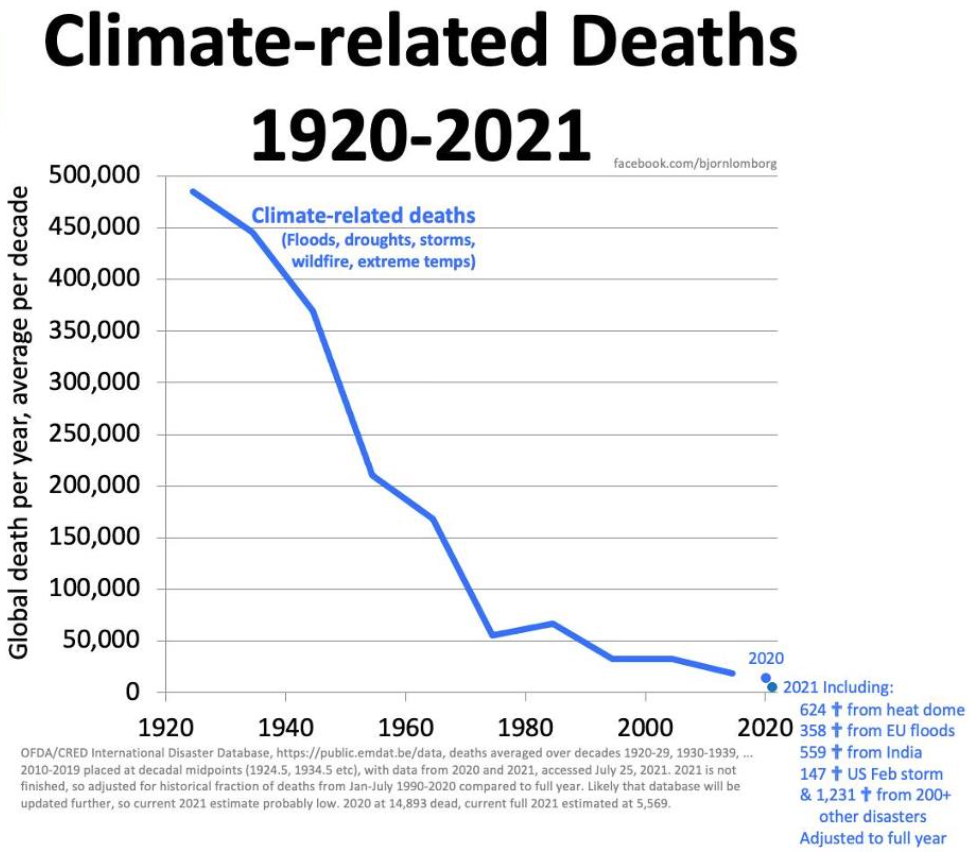
As "nucrow" pointed out in a graph they linked to, the annual number of climate-related deaths from 1920-2021 from about 500,000 to about 10,000. Why? Presumably better weather forecasting and improved infrastructure are part of it.
But rather than optimism, some people are forgoing having kids because they are worried about climate change meaning there is no future for the human race. They are spiraling into dysfunctional despair.
I pointed to Reddit "CollapseSupport" previously to be kind because there is a genuine community there of people helping others deal with their fears, and anyone on HN who really is in despair over this climate change topic might find some help there (among other places).
But if you really want to see what ongoing doomsterism and despair looks like, "/r/collapse" is the companion to that other group:
https://www.reddit.com/r/collapse/
I find it interesting and educational reading -- including about new things to worry about like post-Covid increased violence. There are many anecdotes there about personal despair and local despair. I have to agree many of them are things I share some concern about. The question is, in a world that has invented social media where people can see the worst stories from around the planet due to for-profit algorithms that promote engagement even if it is toxic to the user, do those selected anecdotes add up to an overwhelming trend?
I saw something similar as far as a zeitgeist of worry starting in the 1970s with Peak Oil fears that grew to a crescendo in the early 2000s (e.g. Michael Ruppert, perhaps contributing to his death), and fought against that despair somewhat then in various online discussions. But who really worries about peak oil now with EVs and cheap solar? Yes, it was good to be concerned about the transition, but humanity invented and deployed solutions (in part due to the concern). The USA always had hundred of years of coal supply -- but it would have caused a lot of ecological damage to use it.
I saw another zeitgeist of fear in the 1980s with fear over nuclear war, especially coincidental with the movie "The Day After" and other previous things like the downing of Korean Airlines 007. Sadly, nuclear war is still a very realistic fear, even if such war is ironic, as I suggest in my sig: "The biggest challenge of the 21st century is the irony of technologies of abundance in the hands of those still thinking in terms of scarcity." Odd that the media and most people seem to have mostly stopped worrying about nuclear war over the decades as a day-to-day worry, even though Russia is increasingly rattling the nuclear option a lot.
That is a much more likely apocalypse than climate change, especially since the lives of most US Americans are totally dependent minute-to-minute not so much on the US military's technical prowess as instead on probably-lowly-paid Russian service technicians probably using scrounged parts to maintain a 1970s-era "Dead Hand" computers (which the US tried to sabotage) so they don't launch nuclear missiles accidentally.
https://en.wikipedia.org/wiki/Dead_Hand
I would expect that is the sort of issue that Freeman Dyson too might be more concerned about than rising CO2 levels (including as he wrote a peace-exploring book about the nuclear arms race called "Weapons and Hope").
https://www.goodreads.com/book/show/1028642.Weapons_and_Hope
"In this book, Professor Dyson explores how national decision-makers think about nuclear war, and how this isn't always well-considered or intelligent thought. He also applies the same criticisms to how leaders in various peace and disarmament movements think about nuclear war. The result's an unflinching assessment of how we think about actually using (or defending ourselves from) the world's still-massive stockpiles of nuclear weapons. (Vance Frickey, 2018)"
Of course, there are always other fears like (more?) engineered plagues. Here is a list of my technology-and-society related fears circa 1999: :-) https://www.kurtz-fernhout.com/oscomak/fears.htm
In any case, as linked above at spiked-online, there is a plausible case that rising CO2 is a good thing. And as I previously linked to, it's quite possible that we have already passed the maximum level of atmospheric warming (although there still might be knock-on effects as systems that are reservoirs of "coolth" like the deep oceans continue to absorb heat until some equilibrium point). That means that any effort to reduce fossil fuel emissions and keep CO2 at current levels may be essentially wasted because it won't affect atmospheric warming and it also harms the greening of the planet and the blooming of deserts. So such money would be better spent on either mitigation or other socially beneficial projects (like, for example, eliminating malaria and/or easily curing it?).
In general, these are the sorts of systems effects that Freeman Dyson was concerned might be missing from the models or related policy. He presumably felt some things that should be better understood before making certain broad policy investments. For example, there is an argument that plants growing faster given more CO2 might be weaker or less nutritious (mentioned in part in the article), so another issue to be explored as a system effect.
Personally, I am all for replacing fossil fuels with decentralized renewables like solar and also energy efficiency including passive-solar homes (and maybe someday fusion power, perhaps even via local-scale "Back to the Future" "Mr. Fusion" household systems). Such innovations produce less local air pollution and water pollution than fossil fuels burning does which otherwise harms and even kills a lot of people via health issues (potentially costing in the hundreds of billions of dollars annually plus many lives as an externality of fossil fuel use). Smog and oil slicks are unpleasant to be around and cause a lot of environmental damage to other creatures (including mercury pollution from burning coal which makes many fish unfit to eat much of). Decentralized electrical power sources help shift political power in a more decentralized way too, which can potentially help shift the overly-hierarchical wealth-concentrated society we live in towards a better balance of meshwork/hierarchy (using Manuel De Landa's terms). Such decentralized power systems also tend to be more resilient, with longer time-scales of stand-alone operation, which makes them better to have around in times of most disasters or war. So, we should move away from fossil fuels for those sorts of reasons, not because of potentially-flawed-or-incomplete doomster academic models.
(A supervolcano eruption would definitely be bad for solar though, and we'd be better off with nukes or geothermal or fusion in such circumstances, or even desperately going back to burning fossil fuels for a few years until the air cleared.)
Thanks for the reply. You make an excellent point on the systems aspect of all this. And I personally agree things like poverty, fishery depletion, and so on are important issues to address. But, I am not sure Freeman Dyson intended to imply these are disconnected problems. With his broad-ranging mind, Freeman Dyson was definitely a systems thinker -- though with a bias to quantification. Assuming what you say is true, he might ask, to what degree are those problems made worse by CO2-driven climate change? 1%? 10%? 100%? 1000%?
Assuming that is a significant amount, we can choose to invest some resources to reduce emissions and/or we can choose to invest some resource to mitigate the consequences and/or we can choose to invest resources in some other way like space program, UBI, the arts, creating 1000s of free water-only-fasting and nutritional-reeducation health clinics like True North Healthcare to deal with the "diabesity" crisis overwhelming the USA and making things like respiratory viruses more deadly given comorbidities, to come up with safer plastics and safe ways to detox people of their current microplastics, and so on.
"Woodstock Occurred in the Middle of a Pandemic"
https://www.aier.org/article/woodstock-occurred-in-the-middl...
"Lifespan in the US in those days was 70 whereas it is 78 today. Population was 200 million as compared with 328 million today. It was also a healthier population with low obesity. If it would be possible to extrapolate the death data based on population and demographics, we might be looking at a quarter million deaths today from this virus. So in terms of lethality, it was as deadly and scary as COVID-19 if not more so, though we shall have to wait to see."
Which of those options should we do to what degree? That is the sort of question Freeman Dyson might ask.
On the other hand, maybe the alarms are overblown and CO2 increase at this point is mostly a non-issue?
==== More details
If you want to go one step further in considering systems effects, consider this article from 2022: "Why global warming is good for us: Climate change is creating a greener, safer planet." https://www.spiked-online.com/2022/02/15/why-global-warming-...
"Global warming is real. It is also – so far – mostly beneficial. This startling fact is kept from the public by a determined effort on the part of alarmists and their media allies who are determined to use the language of crisis and emergency. The goal of Net Zero emissions in the UK by 2050 is controversial enough as a policy because of the pain it is causing. But what if that pain is all to prevent something that is not doing net harm? The biggest benefit of emissions is global greening, the increase year after year of green vegetation on the land surface of the planet. Forests grow more thickly, grasslands more richly and scrub more rapidly. This has been measured using satellites and on-the-ground recording of plant-growth rates. It is happening in all habitats, from tundra to rainforest. In the four decades since 1982, as Bjorn Lomborg points out, NASA data show that global greening has added 618,000 square kilometres of extra green leaves each year, equivalent to three Great Britains. You read that right: every year there’s more greenery on the planet to the extent of three Britains. I bet Greta Thunberg did not tell you that. The cause of this greening? Although tree planting, natural reforestation, slightly longer growing seasons and a bit more rain all contribute, the big cause is something else. All studies agree that by far the largest contributor to global greening – responsible for roughly half the effect – is the extra carbon dioxide in the air. In 40 years, the proportion of the atmosphere that is CO2 has gone from 0.034 per cent to 0.041 per cent. That may seem a small change but, with more ‘food’ in the air, plants don’t need to lose as much water through their pores (‘stomata’) to acquire a given amount of carbon. So dry areas, like the Sahel region of Africa, are seeing some of the biggest improvements in greenery. Since this is one of the poorest places on the planet, it is good news that there is more food for people, goats and wildlife."
(I have a lot of issues with Bjorn Lomborg's work, but on that greening I think he is probably mostly correct.)
Also from the article: "But are we not told to expect more volatile weather as a result of climate change? It is certainly assumed that we should. Yet there’s no evidence to suggest weather volatility is increasing and no good theory to suggest it will. The decreasing temperature differential between the tropics and the Arctic may actually diminish the volatility of weather a little."