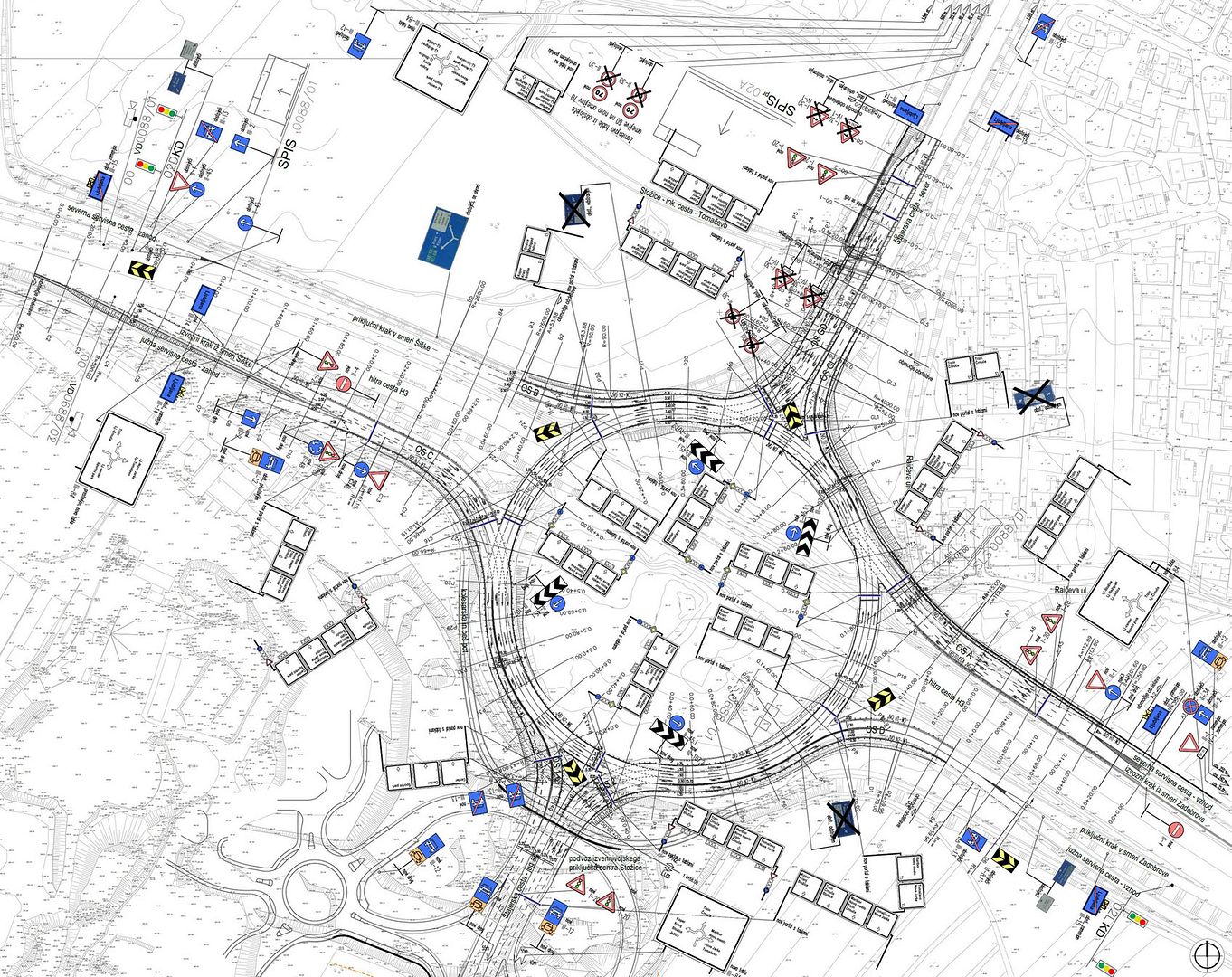
It's going to be really interesting to see what intersections look like once we no longer allow human drivers behind the wheel. We can only hope this will happen during our lifetime.
They will be just like highway intersections in Vietnam where 50kph traffic merges at right angles and percolates across lanes head on. You time it right, or you die.
"And we all know how that's gone in America with the simple roundabout."
Roundabouts are not unpopular, and exist in cities like DC with no one complaining. The reason why roundabouts are unpopular is because city meddlers often put them in places where their purpose is not to mitigate accidents but to attempt to limit speeding through side streets, with negligible (if not negative) effect on traffic safety.
Big things that you can travel quickly into, which are most commonly found on the U.S. East Coast (e.g. Washington, D.C.) are called rotaries, and are generally considered to not be particularly good or safe.
Mid-sized things with splitter islands preceding the entry, and that have an angle of entry that prohibits entering at speed are called roundabouts, and generally are considered a good thing from a speed / efficiency perspective.
Small things with no splitter islands preceding, that are usually put on quiet residential streets (common in Seattle among other places), are called traffic circles. Confusingly, rotaries are sometimes called traffic circles too (see Dupont Circle).
I disagree with your assessment about traffic circles being placed by city meddlers, as well as the assertion that they don't have a positive effect on safety. First, in Seattle and elsewhere, they are typically requested by residents of the street (not us meddling urban planners), and are built where a speeding problem is confirmed, as resources become available, and according to some geographic equity criteria. Second, though I haven't done an exhaustive review of traffic circle literature, this summary review article is bullish on traffic calming features generally, and specifically on traffic calming circles as well: http://jpl.sagepub.com/content/23/4/347.short
Thanks for the terminology clarification. I grew up in the DC area, so to me a 'traffic circle' is all of the above, but thinking of places like dupont circle as the archetype of the 'working' circle.
I didn't say urban planners, I said city meddlers, i.e. select residents of the street. And all the complaints I have ever heard about the (small) traffic circles have been from the residents themselves. There could be a sample bias: I'm a lyft driver; the complaints come from passengers getting dropped off at their homes, usually from nights of drinking.
Of course, speeding through side streets is to be much preferred, the purpose of such streets being solely to permit the swift passage of motorized traffic ;)
The ages of the naysayers in the article were interesting, though this could simply reflect people the journalist and their colleagues knew. To be revisited in 20 years, I think...
The reason why roundabouts don't work in America is that roundabouts solve the wrong problem.
Roundabouts are more efficient when faced with non-extremal traffic densities.
American traffic densities vary from near-zero to near maximal with very little time spent in the middle. Roundabouts are NOT more efficient in that kind of traffic regime.
This reminds me of the great transformation of Drum Hill Rotary into Drum Hill Square:
https://www.google.com/maps/place/Drum+Hill+Rd/@42.6225607,-...
The resulting design is ridiculously confusing and unintuitive. The first time I was driving to it I thought:
"WTF were they thinking? How do I get into the right lane?"
Then it changed to
"Woah, I got lucky, I'm sure I will get confused the next time"
and then
"OK, somehow I keep getting it right"
and
"Wait, I am no longer stuck in traffic here?"
"Not even at 5pm?"
"...woah?"
It's interesting to note that much of the gain in automobile safety over the past 50 years has been offset by an increase in miles driven due to increased sprawl [1].
It seems like this sort of intersection, while possibly being safer, would encourage even more sprawl due to its scale, and pedestrian-unfriendliness.
I also note the the "lights" in the simulation are cycling WAY faster than I have ever seen a traffic light cycle in the US.
A whole lot of intersections in the US would likely improve with that simple "innovation".
People are less likely to crash a yellow-to-red light when they know that their turn is coming again in 30 seconds. Make that 5 minutes and streams of people are going to crash that light.
I used to live near the Mixing Bowl [1] (not exactly an inspiration in city planning), so I just wonder how these would hold up under congestion. The mixing bowl proves you can do anything with ramps (& no lights!), but building flat intersections seems much harder.
Building freeway ramps isn't really that hard, though, so I don't see the point in restricting dimensions. It's good not to let it get out of hand like VDOT, but concrete is pretty cheap. Maybe if you've got a lot of 45mph roads connecting you'd want good lighted designs. Where I live now it's all 40s connecting to 55s connecting to the interstate, so it'd be pretty moot.
Planning for road speeds & traffic rates seem far more important than keeping things flat.
I used to live near a road that was designed similar to the "Continuous flow" model. It wasn't quite that elaborate, but Palatine Rd. just north of Chicago has "local" and "express" lanes. (Or was it Dundee Rd.? I forget.) I have no doubt it flows more efficiently than other roads, but I consistently had people drive into the wrong lane directly at me. I've never had that on other streets. So the question is - do these trade efficiency for basic safety?
Seeing a car moving at high speed on the right in a parallel trajectory is a deeply ingrained alarm bell that I'm in the wrong lane.
US Interstate 35 in Austin at 51st Street used to (may still have) have an overpass lane like this and it took a LONG time to get used to without it causing "Danger Will Robinson" reactions.
amazing. I've always fantasized a "diverging diamond" for the I-5/Genessee exit in San Diego. There are space constraints (the freeway is in a canyon) that prevent more traditional designs, and the exit is a nightmare, causes atrocious traffic snarls.